Ever felt that sinking feeling looking at a quote for a new server? It's a massive, upfront cost for a piece of tech that will eventually become a very expensive doorstop. What if you could handle all that digital heavy lifting as easily as you stream a movie on Netflix?
That’s pretty much what cloud computing is all about.
What Is Cloud Computing and Why Should You Care?
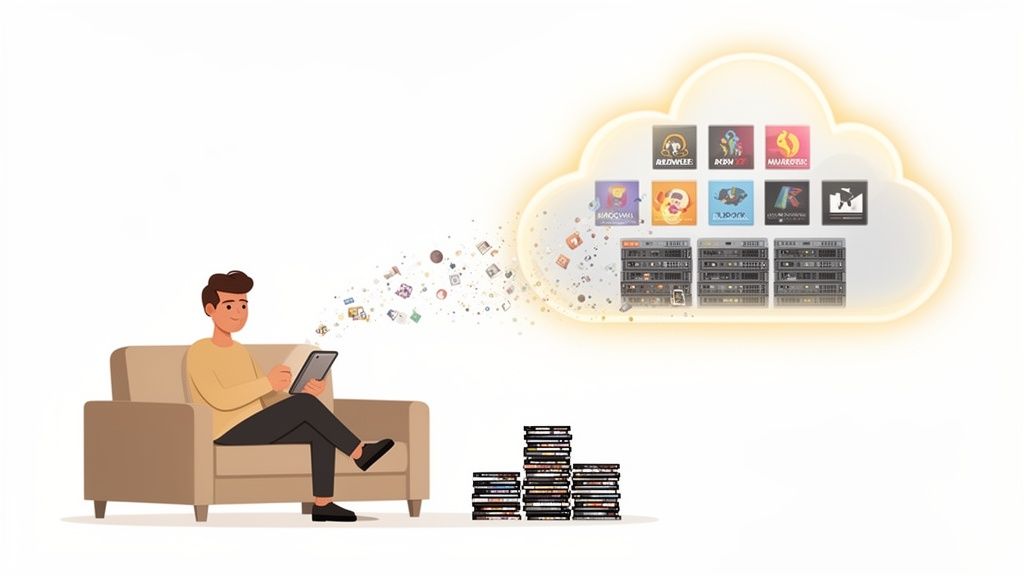
Think about it. Instead of buying and storing a huge collection of DVDs (your own physical servers and hard drives), you just log into a service and access a massive library of content on demand.
The cloud does the exact same thing for your business’s software, data, and processing power. It’s a fundamental shift away from the hassle of owning hardware to simply accessing the services you need, when you need them. This model is the engine behind the scalability, cost savings, and flexibility that Aussie businesses need to compete today.
A Strategic Tool, Not Just a Tech Buzzword
Cloud computing isn’t some abstract concept for IT departments anymore; it’s a core business strategy. The numbers don't lie. Australia's cloud market pulled in a staggering USD 14,981.1 million in 2024, and it's on track to hit an incredible USD 60,745.5 million by 2030. That kind of explosive growth tells you just how baked into our economy the cloud has become.
This rush to the cloud is happening for some very practical, bottom-line reasons.
- Cost Efficiency: You can stop sinking huge amounts of cash into hardware. Instead, you pay a predictable operational cost, much like a utility bill.
- Scalability on Demand: Your resources can flex up or down with your business needs. An e-commerce store, for example, can instantly get more server power for the Christmas rush and then scale back down in January, only paying for what was used.
- Enhanced Security: Reputable cloud providers pour millions into security measures that are simply out of reach for most small businesses. You get to tap into enterprise-grade protection without the enterprise-level price tag. We cover this in more detail in our guide on cybersecurity and data protection.
- Greater Flexibility: Your team can get their work done from anywhere with an internet connection. It’s the key to enabling effective remote work and seamless collaboration.
By moving away from on-premises infrastructure, businesses can redirect their focus from managing hardware to driving innovation and delivering better services to their customers.
In short, cloud computing levels the playing field. It gives small and medium-sized businesses access to powerful, resilient, and secure technology that was once the exclusive domain of big corporations. It’s what keeps you agile, competitive, and ready for whatever comes next.

Performance you can feel, backed by clients who depend on it. Read how our support and uptime create long‑term customer success.Power Your Business with Better Hosting
Breaking Down the Cloud Service Models
Understanding cloud computing is one thing, but figuring out how to actually use it means taking a closer look at how these services are delivered. Not all cloud solutions are the same. They're usually broken down into three main service models, and each one offers a different level of control, flexibility, and convenience.
To keep things simple, let's use the popular 'Pizza as a Service' analogy. It's a fantastic way to explain these concepts because it clearly shows who is responsible for what.
Imagine you're craving a pizza. You have a few ways to get one, and each option lines up perfectly with a core cloud service model. This will help you see how cloud computing provides options that fit different business needs, from complete hands-on control to total convenience.
IaaS (Infrastructure as a Service): The DIY Pizza Kit
First up is Infrastructure as a Service (IaaS), the most fundamental cloud model. Think of this as buying a pizza base, sauce, and all your favourite toppings from the supermarket. You take them home, put the pizza together yourself, and cook it in your own oven.
You don't have to make the dough or sauce from scratch (that's the "infrastructure" the provider gives you), but you're in charge of everything else: the assembly, the cooking time, and how it turns out.
In the tech world, IaaS means you're renting the basic building blocks of IT:
- Virtual Servers: The raw computing power (CPU and RAM).
- Storage: Digital space for your files and data.
- Networking: The connections that link it all together.
With IaaS, you manage the operating system (like Windows or Linux), all the software, and your applications. This model gives you the most control and flexibility. A practical example is a development agency that needs to create custom testing environments for different client projects. With IaaS, they can spin up virtual servers with specific OS versions and configurations on demand. Our Managed VPS plans are a form of IaaS where we provide the high-performance server infrastructure right here in Australian data centres, giving you the freedom to install and configure whatever software your business needs.
PaaS (Platform as a Service): The Take-and-Bake Pizza
Next, we have Platform as a Service (PaaS). This is like ordering a take-and-bake pizza. The pizza shop has already made the base, added the sauce, and arranged all the toppings. All you need to do is take it home and pop it in your oven.
You don't have to worry about the ingredients or the prep work, but you still manage the final baking process.
In cloud terms, PaaS provides all the underlying infrastructure (servers, storage) plus a ready-made environment for development and deployment. This includes operating systems, databases, and programming language support. It’s a huge favourite among developers because they can focus entirely on building and running their applications without getting bogged down managing the complex infrastructure underneath.
A great practical example is a software company using a PaaS solution like Heroku or AWS Elastic Beanstalk to deploy a new web application. They just upload their code, and the platform handles the servers, scaling, and load balancing automatically.
This model is the perfect middle ground when you want to build custom software but don't want the headache of server administration.
SaaS (Software as a Service): The Hot-and-Ready Delivered Pizza
Finally, there’s Software as a Service (SaaS). This is the simplest option of all: you order a pizza online, and it arrives at your door, hot and ready to eat. You don’t manage any part of the process—not the ingredients, the assembly, or the cooking. You just get to enjoy the final product.
SaaS is the most common cloud model, and you're probably already using it every day. These are ready-to-use applications delivered over the internet, usually on a subscription basis. The provider handles absolutely everything: the software, the updates, the security, and all the infrastructure.
Some practical examples of SaaS include:
- Email Services: Think Gmail or Microsoft 365 for your business communication.
- CRM Software: Platforms like Salesforce that help you manage customer relationships.
- Productivity Suites: Tools like our Office 365 for Business, which gives you access to Word, Excel, and Teams without installing any software on a local server.
SaaS is all about convenience. It puts powerful tools directly into your hands without any technical setup required.
Cloud Service Models at a Glance
To make it even clearer, here’s a table that breaks down who manages what in each model. It’s a quick way to see where the responsibility lies between you and the cloud provider.
| Component | Managed by You (Traditional IT) | Managed by You (IaaS) | Managed by You (PaaS) | Managed by You (SaaS) |
|---|---|---|---|---|
| Networking | ✔️ | ✖️ | ✖️ | ✖️ |
| Storage | ✔️ | ✖️ | ✖️ | ✖️ |
| Servers | ✔️ | ✖️ | ✖️ | ✖️ |
| Virtualisation | ✔️ | ✖️ | ✖️ | ✖️ |
| Operating System | ✔️ | ✔️ | ✖️ | ✖️ |
| Middleware | ✔️ | ✔️ | ✖️ | ✖️ |
| Runtime | ✔️ | ✔️ | ✖️ | ✖️ |
| Data | ✔️ | ✔️ | ✔️ | ✔️ |
| Applications | ✔️ | ✔️ | ✔️ | ✖️ |
As you can see, moving from IaaS to SaaS means you hand over more of the technical management to the provider, freeing you up to focus on your business. Choosing the right model really just depends on your goals, your team's technical expertise, and how much control you want to have.
Choosing Your Cloud Environment
Once you’ve figured out which cloud service model is the right fit for your business—whether that’s the hands-on control of IaaS or the simple plug-and-play nature of SaaS—the next big question is where that service will actually live. This is all about picking a deployment model, which really just means deciding how you’ll access and control your cloud resources. Each option strikes a different balance between cost, security, and performance.
To make this a bit clearer, let’s use a simple transportation analogy. Think about all the ways you can get around town. You’ve got different options depending on what you need for a specific trip, and the exact same logic applies to your cloud environment.
This diagram helps break down the service models, showing how Infrastructure, Platform, and Software as a Service stack up.
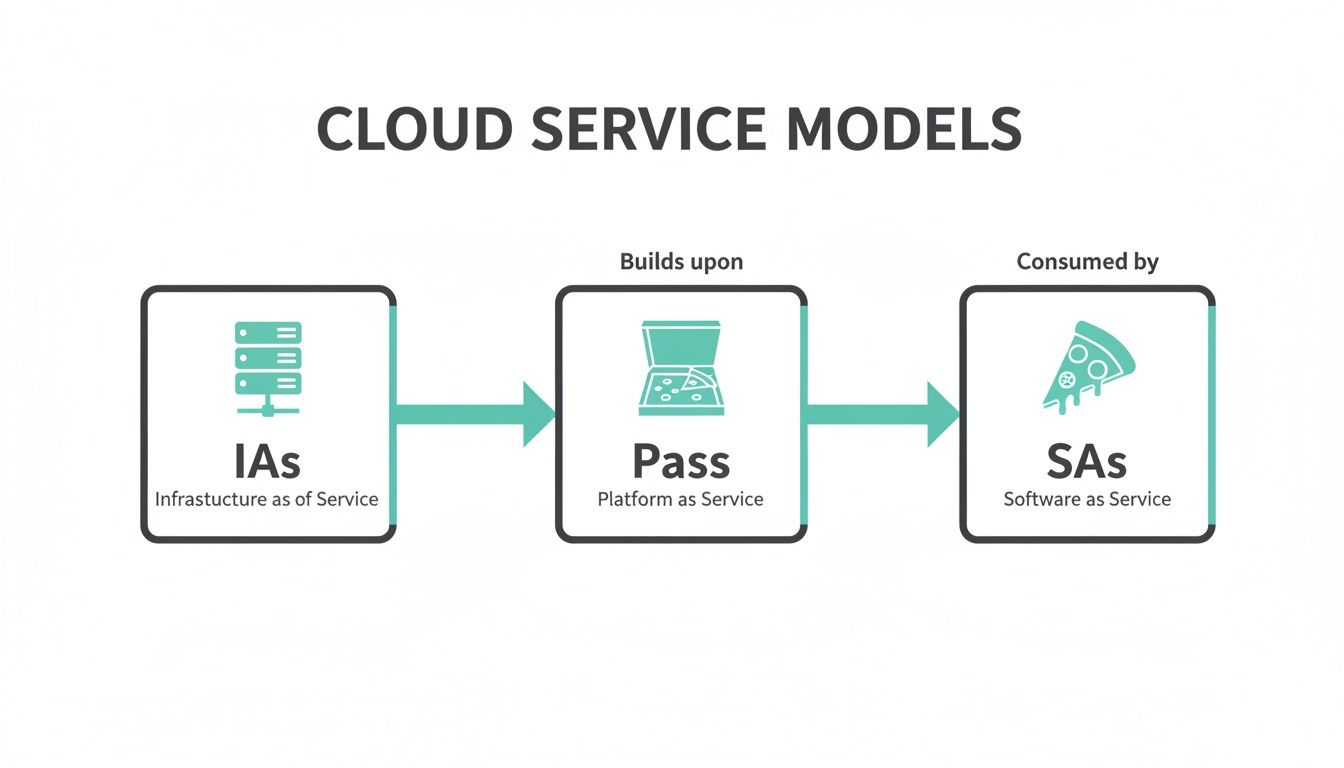
As you can see, each model builds on the one before it. SaaS is the most complete, managed solution, while IaaS gives you the raw building blocks to create your own setup.
The Public Cloud: Your Shared Ride
The Public Cloud is a lot like catching a public bus. It’s an incredibly efficient and affordable way to get where you need to go because you’re sharing the ride—and the cost—with plenty of other passengers. The bus is owned and run by a third-party company; you just pay for your ticket.
In the tech world, public clouds are owned by massive providers like Amazon Web Services (AWS), Google Cloud, and Microsoft Azure. They offer up their huge pool of resources over the internet to anyone who wants to use them.
- Pros: It’s highly scalable, you only pay for what you use, and you never have to worry about maintaining any hardware yourself.
- Cons: You’re sharing resources with other users, or "tenants," which can sometimes cause performance dips (the "noisy neighbour" effect). You also get less fine-grained control over security.
This model is a fantastic starting point for many Aussie small businesses, especially for things like web hosting, developing applications, and storing data. A practical example is a startup using AWS S3 to store its application's user-uploaded images and videos affordably and reliably.
The Private Cloud: Your Own Car
A Private Cloud is the equivalent of owning your own car. You have exclusive use of it, you decide who gets in, and you’re the one responsible for keeping it running. It offers the absolute best privacy and control, but it definitely comes with a higher price tag and a lot more responsibility.
This environment is essentially a set of cloud computing resources used by only one business. It might be located physically in your company’s on-site data centre, or it could be hosted by a third-party provider. The main thing is that all the infrastructure is dedicated solely to your organisation.
- Pros: You get total control over security and hardware, predictable performance without sharing resources, and an easier path to complying with strict data regulations.
- Cons: It's significantly more expensive to set up and manage. Scaling up also requires more planning and a bigger investment.
Private clouds are usually the go-to for businesses with extremely sensitive data or specific regulatory hurdles. For example, a financial services company might use a private cloud to host its core banking application to meet strict data privacy and security compliance requirements. For businesses that want dedicated resources without the massive upfront cost, checking out the best VPS hosting in Australia can offer a similar level of control in a managed, more affordable package.
The Hybrid Cloud: The Best of Both Worlds
The Hybrid Cloud is the most flexible approach of all. It’s a bit like owning a car for your daily commute but grabbing a ride-share for a trip to the airport. You use the best tool for the specific job, mixing and matching the benefits of different models to create a solution that’s just right.
A hybrid cloud combines a private cloud with one or more public cloud services, letting you share data and applications between them seamlessly. This gives businesses a huge amount of flexibility and far more deployment options.
A classic hybrid strategy is keeping sensitive customer data tucked away in a secure private cloud while running your public-facing e-commerce site on a scalable public cloud to handle big traffic spikes during a sale.
This balanced approach is really taking off here in Australia. The demand for scalable and secure solutions is soaring, with public cloud spending alone expected to hit AUD 23.2 billion in 2024. This boom is driven by businesses needing powerful, compliant ways to manage ever-growing mountains of data. For Australian SMBs, the location of these servers is crucial for speed and data sovereignty, which is why having local data centres is a core part of our commitment at UpTime Web Hosting.
Host your website with our 5-star rated, cPanel website hosting plans.
Super fast servers, with security included and hosted in your choice of Australian Data Center.
View cPanel Plans
Real-World Benefits for Your Business Growth
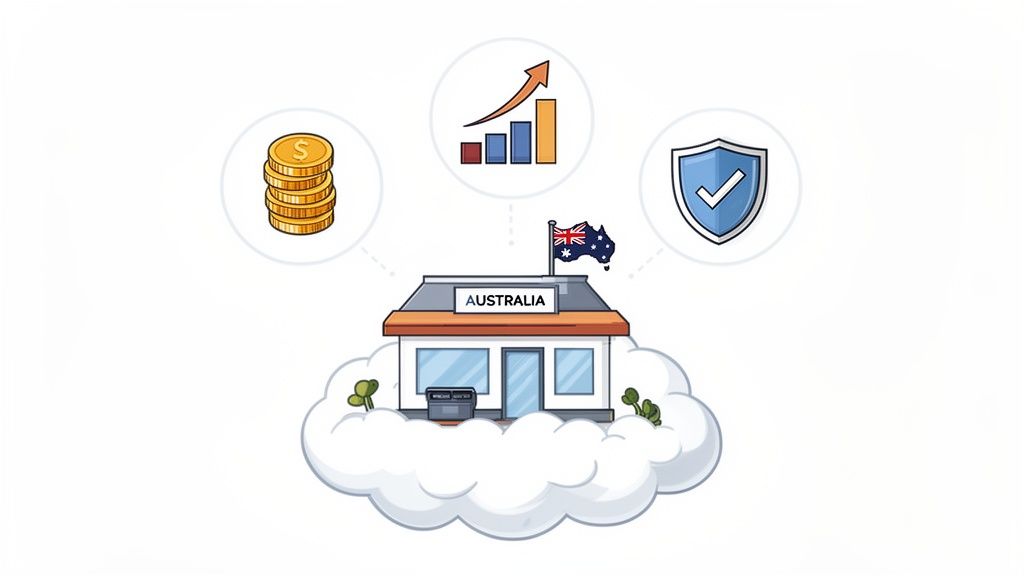
It’s all well and good to talk theory, but how does the cloud actually improve your bottom line and help you grow? For Australian small and medium-sized businesses, the benefits of cloud computing aren’t just technical upgrades; they’re powerful tools for building resilience and getting ahead of the competition.
The shift is happening right across the country. Australia's cloud computing market is set to be worth a massive AUD 20.21 billion in 2025, and it's forecast to explode to AUD 61.88 billion by 2035. This isn't just hype; it's driven by real advantages that give businesses a sharp competitive edge.
Financial Flexibility and Cost Efficiency
One of the first things you'll notice is the freedom from huge upfront hardware costs. In the old days, growing your business meant buying new, expensive servers – a major capital expense that would tie up your cash flow for years.
Cloud computing completely flips this model on its head. Instead of buying assets that lose value over time, you pay a predictable monthly fee. This frees up vital cash that you can put back into things that actually grow your business, like marketing, product development, or hiring new staff.
The pay-as-you-go model makes financial planning much simpler and more predictable. You're no longer guessing what capacity you'll need in three years' time; you're paying for exactly what you use right now, which cuts out waste and makes every dollar in your budget count.
This kind of financial agility gives small businesses the flexibility that was once only available to massive corporations. It makes it far easier to navigate market changes and jump on new opportunities without being held back by big, chunky investments.
Effortless Scalability and Performance
Picture this: your small online store gets a shout-out on a popular morning show. Amazing, right? But then, your website traffic explodes. With traditional hosting on a single server, this dream scenario could quickly become a nightmare as your site crashes under the load, costing you sales and damaging your reputation.
This is where the scalability of the cloud really shines. Cloud infrastructure is built to handle these kinds of ups and downs without breaking a sweat. Resources can be scaled up automatically to manage a huge traffic spike and then scaled back down just as easily when things quieten down.
- Example for a Retailer: An online fashion boutique uses the cloud to handle the massive surge of visitors during its end-of-financial-year sale, ensuring every customer gets a smooth shopping experience.
- Example for a SaaS Company: A new software startup can launch with a small, affordable plan and instantly add more processing power as its user base grows, all without downtime or complicated migrations.
This elasticity means you always have the power you need, delivering a fast, reliable experience for your users while only ever paying for what you actually consume.
Enterprise-Grade Security and Reliability
For most small businesses, setting up top-tier cybersecurity is incredibly expensive and complex. At the same time, the threat of data breaches, malware, and other digital attacks is a constant worry.
When you partner with a quality cloud provider, you get access to a level of security that would otherwise be completely out of reach. These providers invest millions in building and maintaining secure infrastructure, all managed by teams of dedicated experts.
At UpTime Web Hosting, this means you get a multi-layered defence system:
- DDoS-Protected Firewalls: To shield your site from malicious traffic attacks.
- Proactive Malware Scanning: To find and stop threats before they can do any harm.
- Encrypted Nightly Backups: To ensure your data is safe and can be restored in a flash. You can learn more about our secure cloud backup solutions.
For businesses looking to explore advanced AI, cloud platforms also make it possible to develop and deploy tools like Custom ChatGPT solutions. It’s another great example of how the cloud gives small businesses access to powerful, secure technologies on a budget that makes sense.
How to Choose the Right Cloud Solution
So, you've seen what cloud computing can do. The possibilities are huge, but let's be honest, it can all feel a bit overwhelming. With so many options out there, how do you go from understanding the theory to making a practical choice that actually helps your business?
The secret isn't chasing the latest tech buzzword. It's about taking a clear-eyed look at what your business genuinely needs. For most Australian small and medium businesses, this decision boils down to one crucial comparison.
Assessing Your Core Business Needs
Before you can pick a solution, you need to know exactly what problem you're trying to solve. Not all workloads are the same. The best cloud setup for a simple brochure website is worlds away from what a complex, custom-built application requires.
Start by asking a few straightforward questions:
- What are you running? Is it a standard WordPress website, a custom Windows-based application, or a busy e-commerce store? Each has totally different performance and software needs.
- What are your compliance rules? Do you handle sensitive customer data that absolutely must stay in Australia to meet privacy laws? Data sovereignty is non-negotiable for many industries.
- What's your team's tech skill level? Do you have dedicated IT staff who live and breathe server configurations, or do you need a solution where someone else handles all the technical heavy lifting?
- What's your budget look like? Are you after a predictable, fixed monthly cost? Or can you handle a variable pay-as-you-go model that could spike depending on usage?
Answering these honestly gives you a solid framework. A local accounting firm running Windows-based software needs a rock-solid, compliant environment. A blogger just needs a fast, easy-to-manage WordPress setup. Their ideal solutions couldn't be more different.
Hyperscale Cloud vs Managed Hosting for SMBs
For many small businesses, the choice really comes down to two main paths. You can either dive into a massive, do-it-yourself public cloud like Amazon Web Services (AWS) or Microsoft Azure, or you can partner with a specialised managed hosting provider right here in Australia.
While the big "hyperscalers" offer incredible power and a dizzying menu of services, they're often built for huge enterprises with teams of expert engineers. Think of it like this: they hand you a giant box of engine parts, and you have to build the car yourself.
For most SMBs, a managed hosting partner is a much more direct and cost-effective route. You get the keys to a car that's already been finely tuned for performance, safety, and reliability.
Choosing a managed provider means you get the power of cloud computing without the steep learning curve. The provider’s expertise becomes your competitive advantage, handling security, performance, and maintenance so you can stay focused on your business.
To help you decide, here’s a straightforward comparison of what to expect from each option.
Hyperscale Cloud vs Managed Hosting for SMBs
| Consideration | Hyperscale Public Cloud (e.g., AWS, Azure) | UpTime Managed Hosting |
|---|---|---|
| Target Audience | Enterprises and tech startups with in-house IT expertise. | Australian small and medium-sized businesses. |
| Pricing Model | Complex, pay-as-you-go. Can be hard to predict, and costs can escalate unexpectedly. | Transparent, all-inclusive monthly plans with GST included. No hidden fees. |
| Support | Often tiered and self-service. Expert, hands-on support comes at a significant extra cost. | Friendly, local 24/7 Australian support included with all plans. |
| Ease of Use | Requires significant technical knowledge to configure, secure, and manage effectively. | Simple, intuitive control panels (like cPanel) with pre-configured performance tools. |
| Performance | You are responsible for configuring and optimising performance tools, which can be complex. | Performance tools like LiteSpeed and AccelerateWP are built-in and managed for you. |
| Data Sovereignty | Possible to select Australian regions, but configuration is up to you. | All servers are located in Australian data centres, ensuring data sovereignty by default. |
As you can see, the right choice depends entirely on your resources and priorities. For a detailed breakdown, you can learn more about how UpTime Hosting compares to major cloud providers in our guide.
Finding Your Perfect Fit
With your needs mapped out, the path forward becomes much clearer. The goal is to find a solution that nails your specific workload, gives you the right level of support, and has pricing you can actually understand.
- For WordPress Websites: Look for a solution built specifically for it. Our Managed WordPress Hosting plans come with tools like LiteSpeed Cache ready to go, making sure your site is fast and reliable from day one.
- For Custom or Windows Applications: If your business runs on ASP.NET or MSSQL, you need a specialised environment. Our Windows Hosting provides the specific framework and expert support these applications need to run smoothly.
- For High-Traffic Sites or Custom Setups: When you need more grunt and control without the headache of a full hyperscale setup, a managed virtual private server is perfect. Our Managed VPS plans give you dedicated resources and expert management—the best of both worlds.
Ultimately, choosing the right cloud solution is about finding a partner who makes your life easier, not harder. By matching the service to your specific business needs, you cut through the noise and land on a path that delivers predictable costs, reliable performance, and genuine peace of mind.
Got Questions About Cloud Computing? We've Got Answers
Stepping into the world of cloud computing can feel like a big move, and it's totally normal to have a few questions. After all, shifting any part of your business to a new environment is a major decision. We get it. To help clear things up, we’ve put together some straightforward answers to the questions we hear most often from Australian business owners just like you.
This is where we tackle the practical stuff—security, costs, and the technical side of things—and show how having a trusted local partner can make all the difference.
"Is My Business Data Really Secure in the Cloud?"
This is usually the first question on everyone's mind, and for good reason. The short answer? A resounding yes. In fact, a reputable cloud provider can offer a level of security that’s often far more robust than what a typical small business could manage on its own. The real secret lies in choosing the right partner—one that bakes security into every single layer of their service.
Here at UpTime Web Hosting, we don't just store your data; we actively defend it. Our multi-layered approach is designed for peace of mind and includes:
- Free SSL Certificates to encrypt the connection between your website and your visitors.
- Proactive Malware Scanning that hunts down and neutralises threats before they can do any harm.
- Robust, DDoS-Protected Firewalls to act as a shield against malicious traffic attacks.
- Encrypted Off-Site Nightly Backups, ensuring your data is always safe and recoverable.
On top of all that, our Australian data centres are a game-changer for meeting data sovereignty rules. Keeping your sensitive information right here on home soil means it’s protected under Australian privacy laws. You can dive deeper into how we protect your digital assets in our knowledge base article on data protection.
"How Much is This Actually Going to Cost Me?"
One of the best things about the cloud is how it flips your spending on its head. It moves IT costs away from massive, upfront capital expenses (like buying a physical server) to a predictable, manageable monthly operational expense. That’s a huge win for cash flow.
The problem is, the giant public cloud providers often have ridiculously complex pricing models that can lead to "bill shock"—where you get hit with a bunch of unexpected charges. We think there's a better way. We believe in keeping costs simple and completely transparent.
Our hosting plans are built for predictability. We offer all-inclusive pricing where GST is included from the get-go, and there are absolutely no hidden fees. Ever. This makes budgeting for your essential services dead simple and reliable.
This straightforward approach means you can plan your expenses without constantly looking over your shoulder for surprise costs. It lets you focus on what really matters: growing your business. We even offer a big discount on the first invoice for many of our plans to help you get started on the right foot.
"Do I Need a Whole IT Team to Use Cloud Services?"
Not at all. While you'd certainly need some serious technical chops to manage a complex setup on one of the big hyperscale platforms, that's not the only way to do it. Managed cloud services are designed specifically for business owners, not IT gurus.
With a managed solution, the provider does all the technical heavy lifting for you. At UpTime Web Hosting, our team of local experts takes care of everything:
- Server setup and day-to-day management
- Applying critical security patches to keep you safe
- Monitoring performance to catch any issues early
- Optimising the environment for your specific applications
When you combine that with user-friendly tools like the cPanel control panel and our 24/7 Australian support team, you get all the power of enterprise-level cloud computing without needing to be a tech wizard. We manage the infrastructure, so you can manage your business.
"What's the Difference Between Cloud Hosting and Web Hosting Anyway?"
That's a fantastic question, and it really gets to the heart of what makes modern hosting so reliable. Think of traditional web hosting like having your website on a single, standalone computer. If that one machine has a hardware failure or gets overloaded, your website goes down right along with it.
Cloud hosting works on a completely different principle. It uses a whole network of interconnected servers that all work together as one.
This network-based system gives you two massive advantages:
- Superior Reliability: If one server in the network hits a snag, your website can instantly pull resources from other healthy servers to stay online. There's no single point of failure. This built-in redundancy means much, much higher uptime.
- Incredible Scalability: As your website traffic grows, you can add more resources—like processing power or memory—on the fly. This elasticity ensures your site stays fast and responsive, even when you get a sudden flood of visitors.
Every single one of our services at UpTime Web Hosting, from our affordable shared plans to our powerful Managed VPS, is built on these modern cloud principles. This foundation is what allows us to deliver the performance, reliability, and peace of mind that Australian businesses deserve.
Ready to experience a secure, reliable, and easy-to-manage cloud solution for yourself? UpTime Web Hosting offers 100% Australian-based hosting with expert local support to help your business thrive. Explore our plans today at https://uptimewebhosting.com.au.