
You've found a hosting plan advertised at an appealing monthly price. The website looks professional, the sign-up form is quick, and the first invoice seems affordable. Then the renewal arrives, a setup charge appears, and an “essential” backup or email feature turns out to cost extra. The website is online, but the bill no longer looks like the offer you compared.
For an Australian small business, hosting is a recurring operating cost, not a one-off purchase. Transparent pricing means you can identify the full amount payable before committing, understand what will change later, and leave without losing control of your website, email, domain or data.
Table of Contents
- The Hidden Costs Behind Cheap Hosting Headlines
- What Transparent Pricing Means Under Australian Law
- Understanding GST Inclusion in Hosting Prices
- Evaluating Total Cost of Ownership Beyond Monthly Fees
- The Overlooked Aspect of Cancellation and Post-Purchase Control
- Choosing a Transparent Australian Hosting Provider

Performance you can feel, backed by clients who depend on it. Read how our support and uptime create long‑term customer success.Power Your Business with Better Hosting
The Hidden Costs Behind Cheap Hosting Headlines
A café owner in Brisbane chooses a hosting plan after comparing several monthly prices. The advertised figure fits the budget, so she connects the business domain and starts preparing the new website. At checkout, the total includes a setup fee. The plan also requires a paid backup option, and the renewal price is shown in smaller text beneath the introductory offer.
The first bill is manageable, but the next billing period creates a problem. The owner had budgeted for the headline amount, not the standard renewal cost plus compulsory extras. She now has to decide whether to absorb the unexpected expense, move the website again, or spend valuable time finding out what the original offer included.

Why drip pricing causes confusion
Treasury describes drip pricing as a practice where a low headline amount appears first and additional charges are disclosed progressively during the buying process. The customer may see the actual cost only after choosing a plan, entering payment details or reaching the final checkout screen.
Research shows that consumers in sectors using hidden or incremental fees can pay up to 40% more than the initially advertised price, while 74% of consumers found it difficult to compare prices across businesses because of drip pricing, according to Australian Treasury consultation material on unfair trading practices.
For hosting, the common trouble spots are easy to recognise:
- Introductory pricing: The first invoice is discounted, but the standard renewal amount isn't immediately visible.
- Mandatory extras: Setup, migration, administration, payment or backup charges appear after the headline price.
- Unclear billing terms: The page doesn't explain whether the displayed amount is monthly, annual, GST-inclusive or promotional.
- Optional features presented as necessities: Extra storage or resources may be useful, but they shouldn't be confused with charges required to run the plan.
A useful starting point is this guide to hidden costs of budget web hosts. Before comparing providers, write down the amount charged today, the normal renewal amount and every compulsory addition. That simple list turns an attractive headline into a cost you can assess.
Practical rule: If you can't identify the full compulsory cost before payment, you aren't comparing hosting plans yet. You're comparing advertisements.
What Transparent Pricing Means Under Australian Law
A hosting page shows A$10 per month, but checkout reveals an annual commitment, GST, and a compulsory setup charge. The customer has not been given a useful total. They have been shown a starting component, while the cost of owning the service remains unclear.
Australian consumer law sets a standard for businesses that display prices. Section 48 of the Australian Consumer Law requires a business that advertises only part of a price to also display the minimum quantifiable total price as a single figure and with at least equal prominence, including unavoidable taxes, duties, fees, levies and other compulsory charges such as GST. The requirement is explained in Australian Treasury material on drip pricing and unfair trading practices.
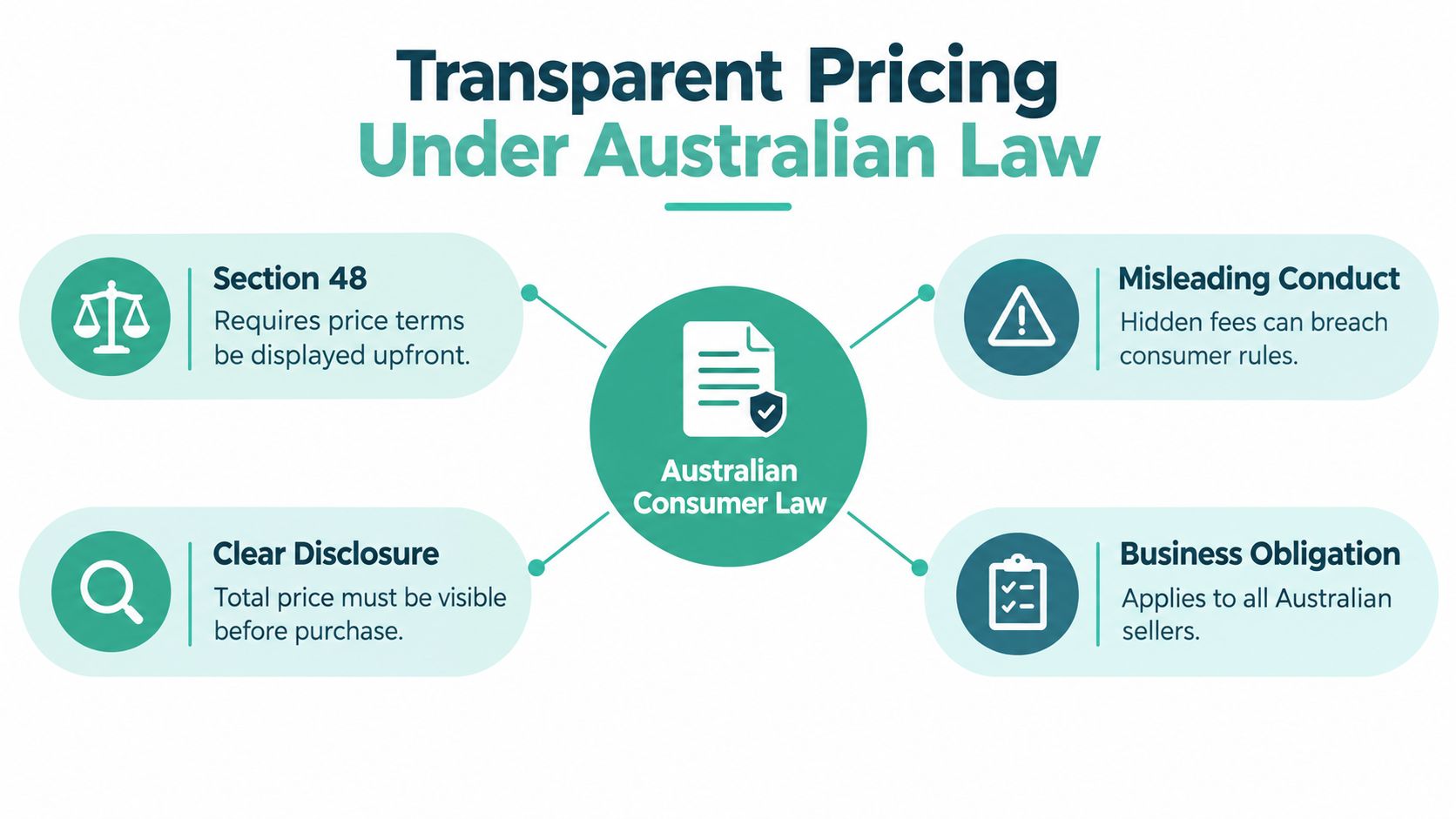
The single figure customers should see
Suppose the advertised monthly amount applies only when a customer pays for a longer term. The page should show the complete payable total for that commitment as one figure, with at least equal prominence. A small business should not have to reconstruct the cost from fine print, separate screens, or a calculator.
The same principle applies online. Australian Government electronic-commerce guidance supports displaying a single-figure minimum total price prominently, including compulsory delivery, postage and handling charges where relevant. For hosting, the comparable question is whether unavoidable service, administration, setup, migration, or transaction charges are included before payment.
The ACCC guidance on price displays is useful when reviewing an offer. A component price can mislead if a customer could reasonably mistake it for the final amount, especially when GST or another unavoidable charge is added later.
Mandatory and optional costs aren't the same
A transparent provider may offer upgrades. The dividing line is whether the customer must purchase them to use the advertised service.
| Cost type | How it should appear |
|---|---|
| Hosting plan and compulsory charges | Included in the prominent total price |
| GST and other unavoidable taxes | Included in the displayed Australian price |
| Optional backups, resources or upgrades | Listed separately and clearly marked optional |
| Promotional discount | Shown beside the amount charged and the normal price |
| Renewal billing | Displayed before purchase, not hidden after the first term |
Post-purchase control matters as well. The offer should explain how renewal works, what notice is required to cancel, whether cancellation stops the next charge, and whether a customer can cancel through the account or must contact support. A low introductory price does not provide transparency if leaving the service is difficult or the renewal terms appear only after payment.
For a practical check, select a plan and proceed to checkout. Compare the final total with the pricing page, then read the renewal notice, cancellation wording, and invoice. The pricing page, checkout, and billing system should describe the same commitment.
You can also review Australian website legal requirements when assessing the wider responsibilities connected with running a business website. Clear pricing helps an Australian SMB understand its true cost before purchase and retain control afterwards.
Host your website with our 5-star rated, cPanel website hosting plans.
Super fast servers, with security included and hosted in your choice of Australian Data Center.
View cPanel Plans
Understanding GST Inclusion in Hosting Prices
GST can make two apparently similar hosting prices difficult to compare if one is inclusive and the other isn't. Australian businesses need to know whether the amount on the page is the amount that will be charged, rather than assuming a pre-GST figure is the final cost.
Australia's GST rate is 10%, and GST equals one-eleventh of the GST-inclusive amount charged. A business must display a GST-inclusive price as soon as it knows Australian GST is likely to apply, according to the Australian Taxation Office guidance on online sales to Australia.
Read the total, not just the tax label
If a hosting service is advertised at A$110 including GST, the GST component is A$10 and the pre-GST value is A$100. If the total is A$100 including GST, the GST component is A$9.09, because the tax is calculated as one-eleventh of the inclusive amount.
Those examples matter because a page showing A$100 plus GST doesn't describe the same payable amount as a page showing A$100 including GST. The wording beside the price should make the difference obvious. Look for “GST included”, “including GST” or an equivalent statement, and check whether the invoice uses the same treatment.
What a clear hosting invoice contains
A useful invoice should identify the service, billing period, taxable supply and total paid. The ATO permits a tax invoice to show the GST amount separately or to state “Total price includes GST” where the GST is exactly one-eleventh of the total price. The relevant ATO tax invoice guidance explains these mechanisms.
Before choosing a plan, compare like with like:
- Confirm the currency: Australian dollars make budgeting easier for an Australian business.
- Check GST treatment: Make sure the displayed figure includes GST where it is likely to apply.
- Compare billing periods: A monthly price may not reveal the total charged for an annual term.
- Match the invoice: The amount and tax treatment at checkout should match the later billing record.
For a broader budgeting view, use this guide to annual web hosting cost and record both the recurring service amount and any one-off charges. GST-inclusive prices make that calculation much more straightforward.
Evaluating Total Cost of Ownership Beyond Monthly Fees
A café owner chooses hosting after seeing a low monthly price. The first invoice includes a promotion, then migration support appears as a separate charge. At renewal, the standard rate is higher, and the website needs a larger resource allowance. Each charge is explainable, yet the original headline no longer describes what the business pays to keep its site running.
A monthly price is one piece of the bill, much like a budget airline fare before baggage and seat charges. The useful question is how much the website costs to start, operate, renew and eventually leave. Total cost of ownership brings those stages into one comparison.
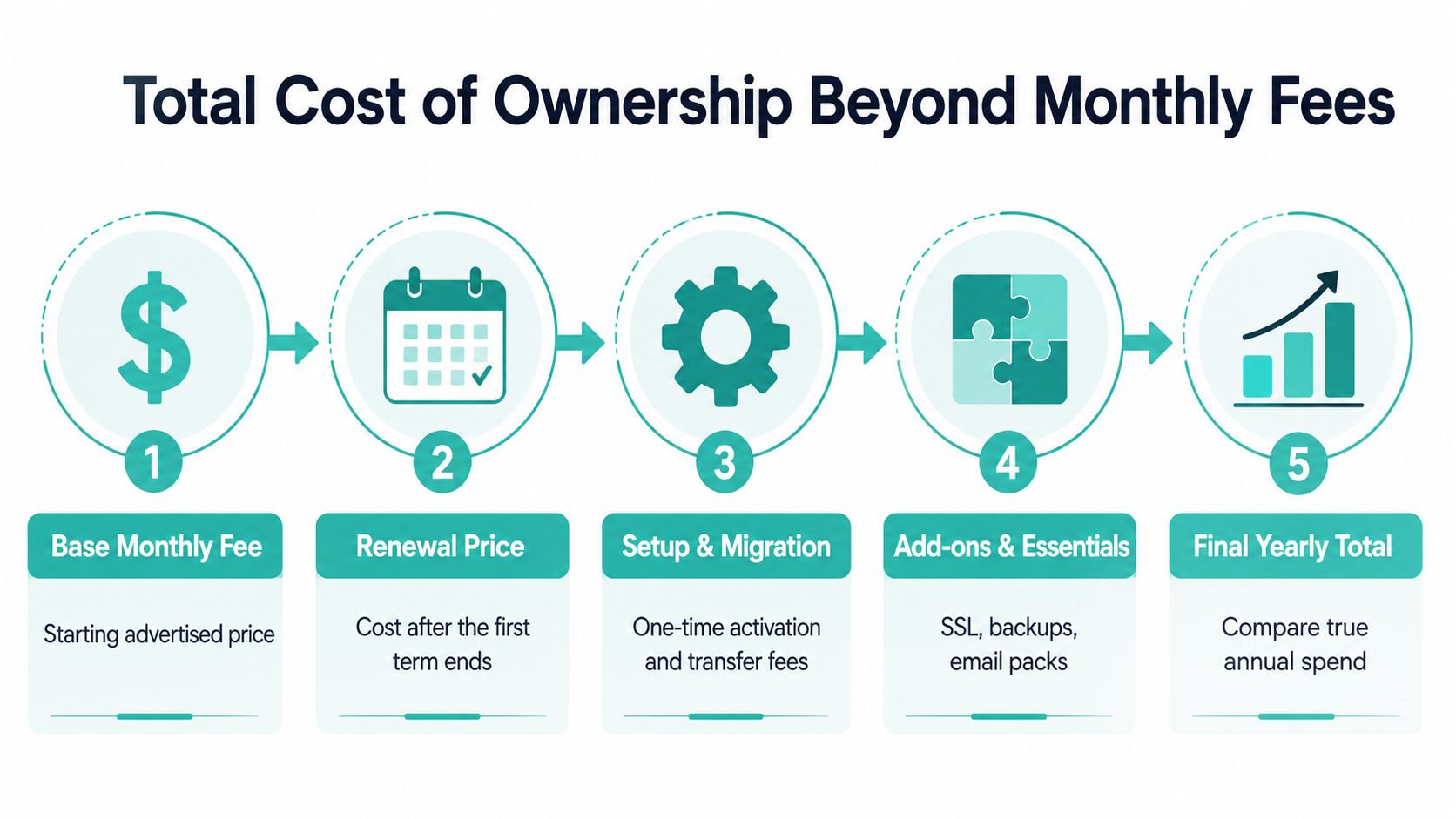
Build the calculation from the invoice outward
Use a comparison sheet instead of relying on the pricing banner. Record:
- Amount charged today: Include GST and any compulsory setup or activation cost.
- Promotion end point: Note when the introductory offer stops.
- Standard renewal price: Treat this as the normal ongoing cost, not the promotional figure.
- Required additions: Include migration, backups, email, resource increases and other compulsory items.
- Exit costs: Check cancellation, refunds, data export and domain-transfer conditions.
A 50% introductory discount describes a temporary promotional period, not the plan's ordinary price. Record the discounted amount beside the post-discount amount, along with the date or term when the offer ends. If the renewal price is not visible before purchase, ask the provider to confirm it in writing.
This record also helps separate predictable costs from optional extras. A backup upgrade may be useful, while a migration charge may apply only at the beginning. Label each item as recurring, one-off, included or conditional, so a small line on the pricing page does not become an unexpected invoice item later.
Compare the same service over the same period
A monthly figure can conceal the difference between a short promotional term and a longer commitment. Add migration charges before comparing plans. If one package includes an important backup service and another treats backups as an upgrade, compare the equivalent package rather than the base labels.
The same price-display principle supports showing the complete total where a business advertises a component price within a longer contract. It also gives businesses a practical checking method. The pricing page, checkout screen, billing record and renewal notice should present the same amount payable under the same conditions.
For wider budgeting context, the guide to website cost Australia 2026 can help separate hosting from other website expenses. Keep those categories distinct. Design, content, maintenance and hosting may support one online presence, but combining them into one monthly figure makes comparisons harder.
A sound comparison asks what you will pay after the welcome offer ends, what you must add to operate the site, and what it will cost to take your data elsewhere.
The Overlooked Aspect of Cancellation and Post-Purchase Control
A hosting offer isn't fully transparent if it explains how to join but not how to leave. The monthly price may be clear while the cancellation process, refund rules, backup retention and domain-transfer conditions remain difficult to find.
This matters when a business changes direction, closes a website or moves to a different service. You need to know whether cancellation is available through the account, whether a support request is required, when the service stops, and what happens to email, website files, databases, backups and domains.

Cancellation is part of the total cost
Australian consumer research reported that 48% of Australians spent longer than intended trying to cancel a subscription, three-quarters experienced some negative cancellation experience, and 10% ultimately gave up, as reported in coverage of Australian subscription cancellation research.
The figures highlight a broader point for hosting customers. A low fee paired with difficult cancellation shifts part of the cost into staff time, renewal risk and uncertainty. The price may look acceptable, but the customer has less control over the service.
Ask these questions before signing up:
- Online cancellation: Can an authorised account user cancel without calling or sending repeated requests?
- Renewal timing: When does the service renew, and how are reminders delivered?
- Prepaid time: Is unused prepaid time refundable, transferable, or lost?
- Service shutdown: When will the website, email and other services stop after cancellation?
- Data export: How can website files, databases, mailboxes and backups be retrieved?
- Domain control: Can the domain be transferred, and what information is needed?
- Backup retention: How long are backups kept after the account ends?
Proposed Federal Government subscription reforms point towards clearer information before sign-up, advance notice before a free trial ends and fewer unreasonable cancellation barriers. For an Australian business, the practical response is simple. Read the exit terms with the same attention you give the price, and keep a copy of the provider's cancellation and data-handling information.
Register your new domain name at competitive market prices including free domain add-ons like privacy, DNS Hosting, Custom Nameservers and Forwarding.
Always the best price and no nasty renewal price hikes.
Register A Domain Name
Choosing a Transparent Australian Hosting Provider
A transparent provider makes comparison possible without detective work. The price page should show the amount charged now, the normal renewal price, GST treatment and billing period. Optional upgrades should sit apart from compulsory charges, and cancellation instructions should be easy to locate before you create an account.
Use this checklist when comparing Australian hosting services:
- Renewal clarity: Is the post-promotion price displayed beside the introductory amount?
- GST treatment: Does the Australian price state that GST is included?
- Checkout consistency: Does the final total match the prominent price on the plan page?
- Essential features: Are SSL, backups, email or migration included, or clearly priced separately?
- Exit control: Can you cancel online, export your data and transfer your domain without unnecessary obstacles?
- Local service: Does the provider explain its Australian support arrangements and infrastructure?
A clear offer might show a GST-inclusive amount, state exactly what is charged on the first invoice, identify the renewal amount and note that optional resources cost extra. An opaque offer might show only a low monthly number, place compulsory fees in later steps and leave cancellation details inside a support article. Both may use similar technical language, but only one makes the business cost easy to forecast.
For a side-by-side decision process, use this Australian web hosting comparison and check each plan against the same questions. Local Australian support and infrastructure can also make it easier to resolve billing, migration and data-access issues when the website supports day-to-day operations.
UpTime Web Hosting offers Australian hosting with GST-inclusive pricing, stated promotional and renewal terms, no contracts, and no hidden checkout fees, alongside services such as WordPress, cPanel, email, domains and managed VPS hosting. Review the UpTime Web Hosting plans and compare the complete cost, included features and cancellation terms before choosing a home for your business website.