In short
Ransomware data recovery services can often restore business data when clean backups, usable snapshots or a verified decryptor exist. A credible provider first contains the incident, preserves evidence, checks whether data was stolen, rebuilds affected systems and validates the restore. Paying an attacker is not a reliable recovery method.
Key takeaways
- Recovery from clean backups is usually more predictable than decryption or file reconstruction, but the restore point must be isolated and checked before use.
- A completed backup job is not proof that a business can restore its applications, settings and data within an acceptable time.
- Incident response, forensic investigation, backup restoration and physical data recovery are different services, and one provider may not cover all four.
- The Australian Government discourages ransom payments because payment does not guarantee access or prevent stolen information from being leaked, according to ASD’s ACSC ransomware recovery guidance. (cyber.gov.au)
- Since 30 May 2025, certain Australian entities that make ransomware or cyber extortion payments must report them within 72 hours under the regime explained in Home Affairs’ 2025 reporting factsheet. (homeaffairs.gov.au)
Table of contents
- What should you do if ransomware is active right now?
- Can ransomware data be recovered?
- Which type of ransomware recovery specialist do you need?
- What should a ransomware data recovery service do before restoring files?
- Why is paying the ransom not a recovery strategy?
- How do you compare ransomware data recovery services?
- What should you prepare before an incident?
- What else do businesses ask about ransomware recovery?
- What should you do next?
The phrase ransomware data recovery services sounds like one service. In practice, it can describe emergency containment, forensic investigation, restoration from backup, decryption, database repair, virtual-machine reconstruction or physical media recovery.
That distinction matters. Calling a backup provider when an attacker is still active may leave the intrusion uncontained, while sending a healthy server to a physical data recovery laboratory will not solve stolen credentials or compromised cloud accounts.

Performance you can feel, backed by clients who depend on it. Read how our support and uptime create long‑term customer success.Power Your Business with Better Hosting
What should you do if ransomware is active right now?
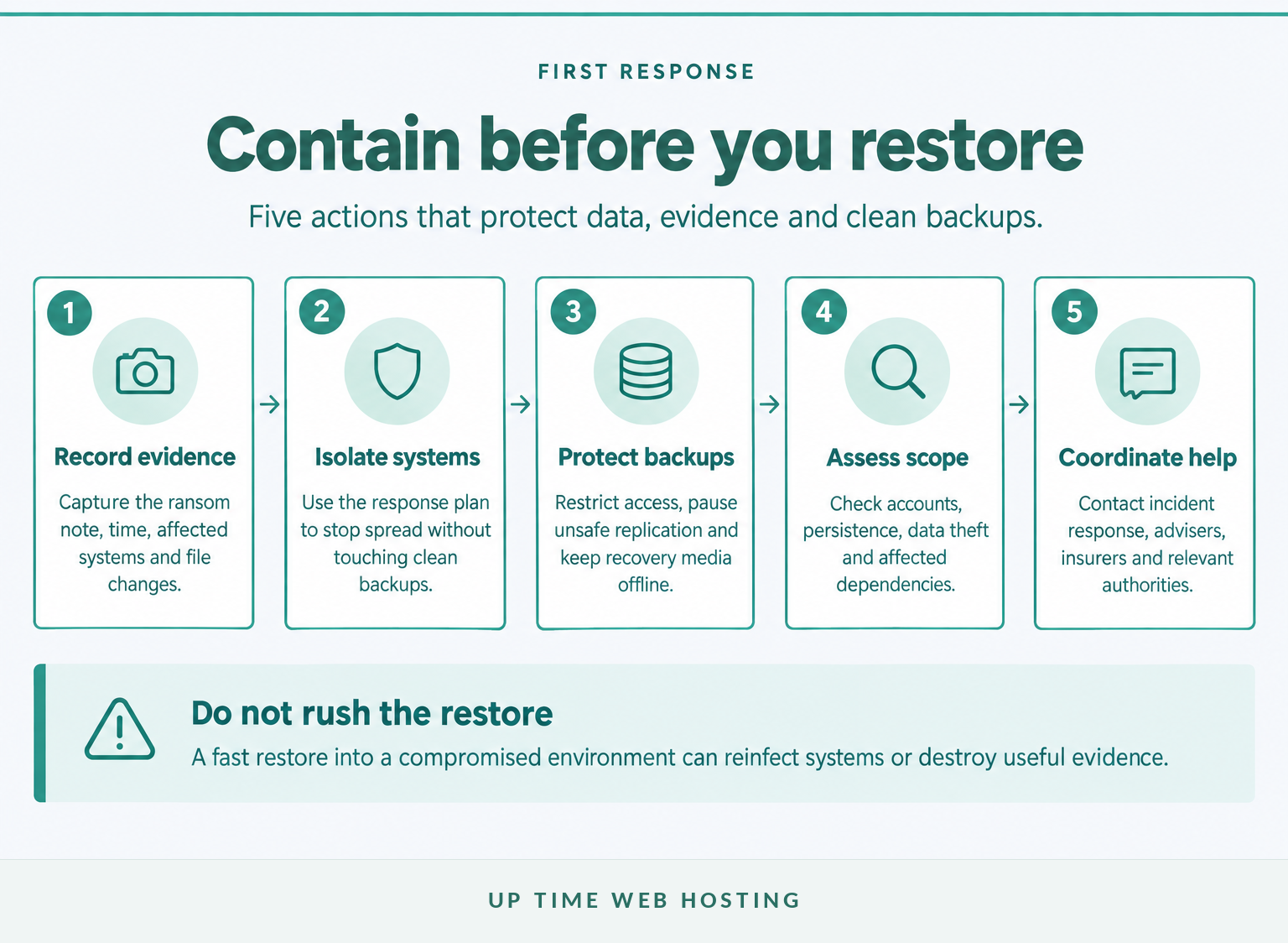
If ransomware is active, contain the incident before attempting any restore. Record the ransom note and affected systems, isolate compromised devices or network segments, protect backup repositories and call an incident-response specialist from a known-clean communication channel.
The ASD’s ACSC emergency guidance tells victims to record key details, stop the spread and seek professional help. For organisations with an established technical response capability, ASD’s incident response planning guidance also calls for containment, documentation and evidence preservation. (cyber.gov.au)
Take these initial actions through the organisation’s approved incident process:
- Move incident communications to a known-clean phone, device or account.
- Isolate affected devices, accounts, remote access and network segments using the pre-agreed method.
- Restrict access to backup consoles and stop unsafe replication that could copy encrypted or deleted data.
- Preserve ransom notes, screenshots, unusual file extensions, security alerts and relevant logs.
- Contact the incident lead, cyber insurer, legal or privacy adviser and technical response provider as applicable.
A written ransomware recovery plan should already identify who can isolate systems, who controls the backups and who can approve a return to production. Improvising those decisions during an attack wastes time and can damage evidence.
Containment and evidence preservation come before restoration.
Can ransomware data be recovered?
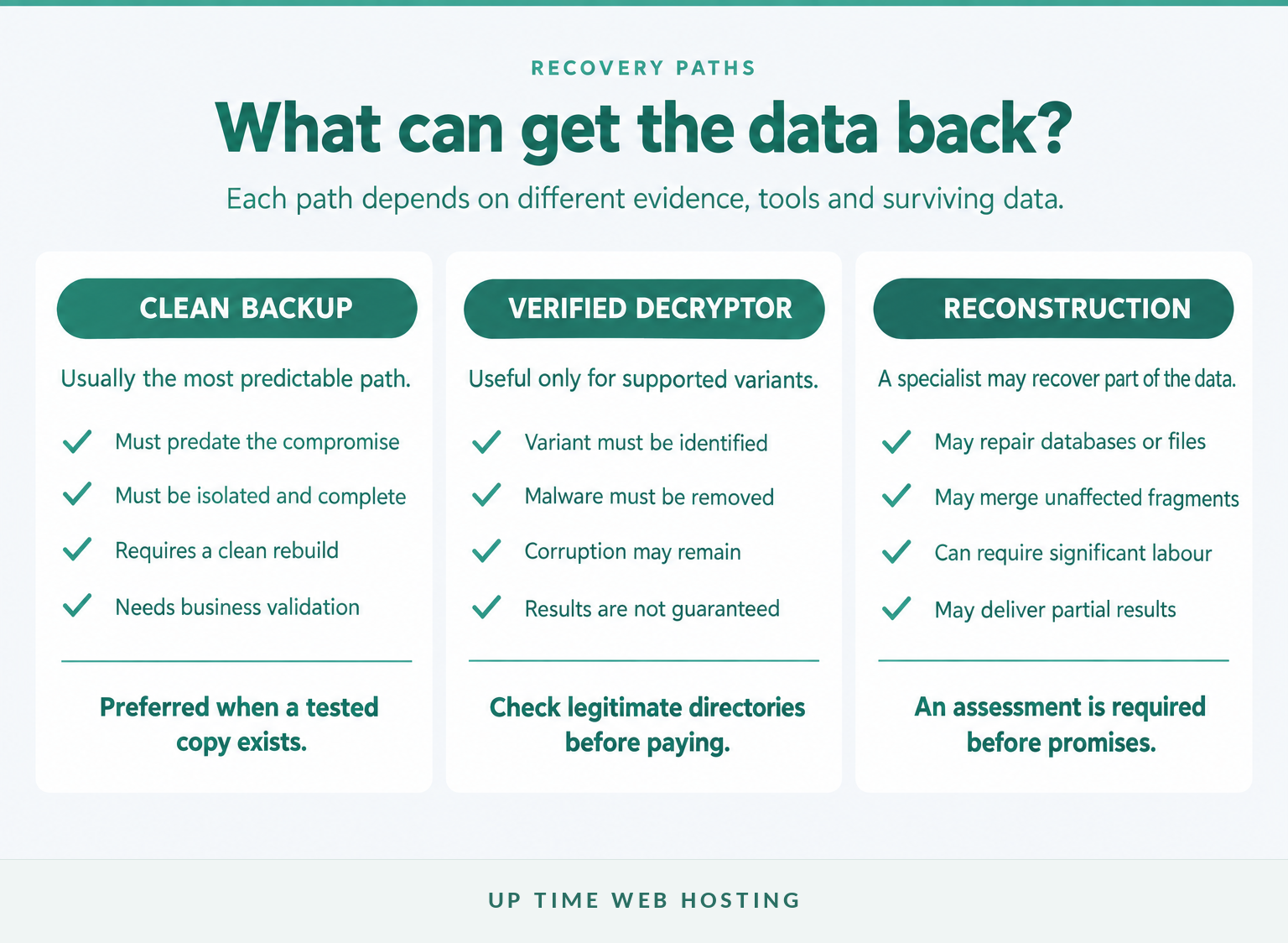
Yes, a business can sometimes recover data after ransomware, but the available path depends on what survived the attack. Clean backups are usually the most predictable option; decryption and specialist reconstruction are conditional and may recover only part of the data.
Recovery generally follows one or more of these paths:
- Clean backup restoration: Recover data, applications and settings from a point before the compromise, then restore them to rebuilt systems.
- Protected snapshots or version history: Recover earlier versions only when the attacker could not alter or delete them.
- Verified decryption: Use a tool matched to the identified ransomware variant. The No More Ransom decryption tools directory lists tools for supported variants and warns that malware should be removed before decryption begins. (nomoreransom.org)
- Specialist reconstruction: Repair databases, merge usable file fragments, reconstruct virtual machines or recover unaffected portions of partially encrypted data.
Do not confuse cloud synchronisation with an independent backup. ASD’s backup guidance warns that ransomware-encrypted files may also be synchronised to cloud storage, while a suitable backup service should retain older recoverable versions. (cyber.gov.au)
Restoring files also does not prove that the attacker has been removed or that information was not copied. Recovery must address system integrity and possible data exposure as well as file availability.
Recovery is possible only when a clean, usable path exists.
Host your website with our 5-star rated, cPanel website hosting plans.
Super fast servers, with security included and hosted in your choice of Australian Data Center.
View cPanel Plans
Which type of ransomware recovery specialist do you need?
The right lead provider depends on whether the urgent problem is an active intrusion, an unusable backup, encrypted data or a damaged physical device. A business may need several specialists working under one incident lead rather than one supplier claiming to do everything.
| Situation | Lead specialist | Primary job |
|---|---|---|
| The attacker may still have access | Incident response and digital forensics | Contain the intrusion, preserve evidence, determine scope and remove persistence |
| Tested clean backups are available | Managed backup and recovery provider | Rebuild the recovery environment, restore priorities and validate data |
| Backups are missing, damaged or encrypted | Logical data recovery or decryption specialist | Assess the variant and attempt decryption, repair or reconstruction without guaranteeing success |
| A hard drive or storage device is physically failing | Physical media recovery specialist | Image and stabilise the failing media before logical recovery work |
| Personal information, insurance or contractual duties may be involved | Privacy, legal and insurance advisers | Assess obligations, approvals, notifications and communications |
Ask each provider to identify the work it performs itself, the work it refers elsewhere and the person who coordinates the complete incident. The written scope should also state whether containment, malware removal, credential resets, application rebuilding and post-restore monitoring are included.
Choose the lead specialist by the problem that must be solved first.
What should a ransomware data recovery service do before restoring files?
A credible service should prove that the recovery environment and selected restore point are safe enough before data returns to production. Restoration should follow containment, scope assessment and evidence protection, not replace them.
ASD’s current incident guidance says containment should minimise damage, prevent escalation and stop malicious actors from destroying evidence. Its September 2026 Information Security Manual guidance also requires investigators to record their actions and maintain evidence integrity and chain of custody. (cyber.gov.au)
A sound recovery sequence is:
- Establish clean recovery control. Use known-clean administrator devices, communications and credentials that do not depend on the compromised environment.
- Determine the affected scope. Identify compromised accounts, systems, network segments, cloud services, applications and possible data theft.
- Protect the evidence and backups. Preserve logs and original artefacts, restrict backup administration and work from forensic copies where required.
- Close the attack path. Patch the exploited weakness, remove persistence, rotate unsafe passwords, keys and tokens, and rebuild affected operating systems where practical.
- Restore in dependency order. Recover identity, network and security visibility before applications that depend on them, then restore business services by approved priority.
- Validate before reconnection. Scan the restored environment, reconcile records, test real business tasks and monitor for recurring malicious activity.
Backup location alone does not make a copy safe. Effective off-site backup solutions should be combined with protected credentials, suitable retention and a tested restoration method, while disaster recovery determines how systems and dependencies return to operation.
An off-site copy can remain vulnerable when production credentials can modify it. An offline or immutable copy can still fail if it is incomplete, too old or never tested, so the provider should demonstrate a real restore rather than showing only successful backup notifications. (cyber.gov.au)
A safe restore rebuilds trust in the environment before it restores data.
Why is paying the ransom not a recovery strategy?
Paying an attacker does not establish that systems are clean, files are complete or stolen information will remain private. The Australian Government strongly discourages ransom payments because access may not be restored and the victim may be targeted again.
A decryptor supplied by an attacker can also be slow, unstable or unable to repair corrupted data. Even when files become readable, the business still needs to investigate the intrusion, remove persistence, reset compromised credentials, rebuild unsafe systems and assess possible data theft.
As of October 2026, mandatory payment reporting applies to certain critical infrastructure entities and businesses captured by the Cyber Security Act 2024 regime, including businesses with annual turnover of A$3 million or more under the Home Affairs guidance. A report is required within 72 hours after making a ransomware or cyber extortion payment, or becoming aware that a payment was made on the entity’s behalf. (homeaffairs.gov.au)
A ransomware event may also be a notifiable data breach. OAIC’s 29 June 2026 data breach guide tells covered entities to contain the breach, assess the facts and risk of harm, notify when required and review the incident. Obtain legal advice for the organisation’s circumstances. (oaic.gov.au)
A ransom payment buys uncertainty, not a verified recovery.
Register your new domain name at competitive market prices including free domain add-ons like privacy, DNS Hosting, Custom Nameservers and Forwarding.
Always the best price and no nasty renewal price hikes.
Register A Domain Name
How do you compare ransomware data recovery services?
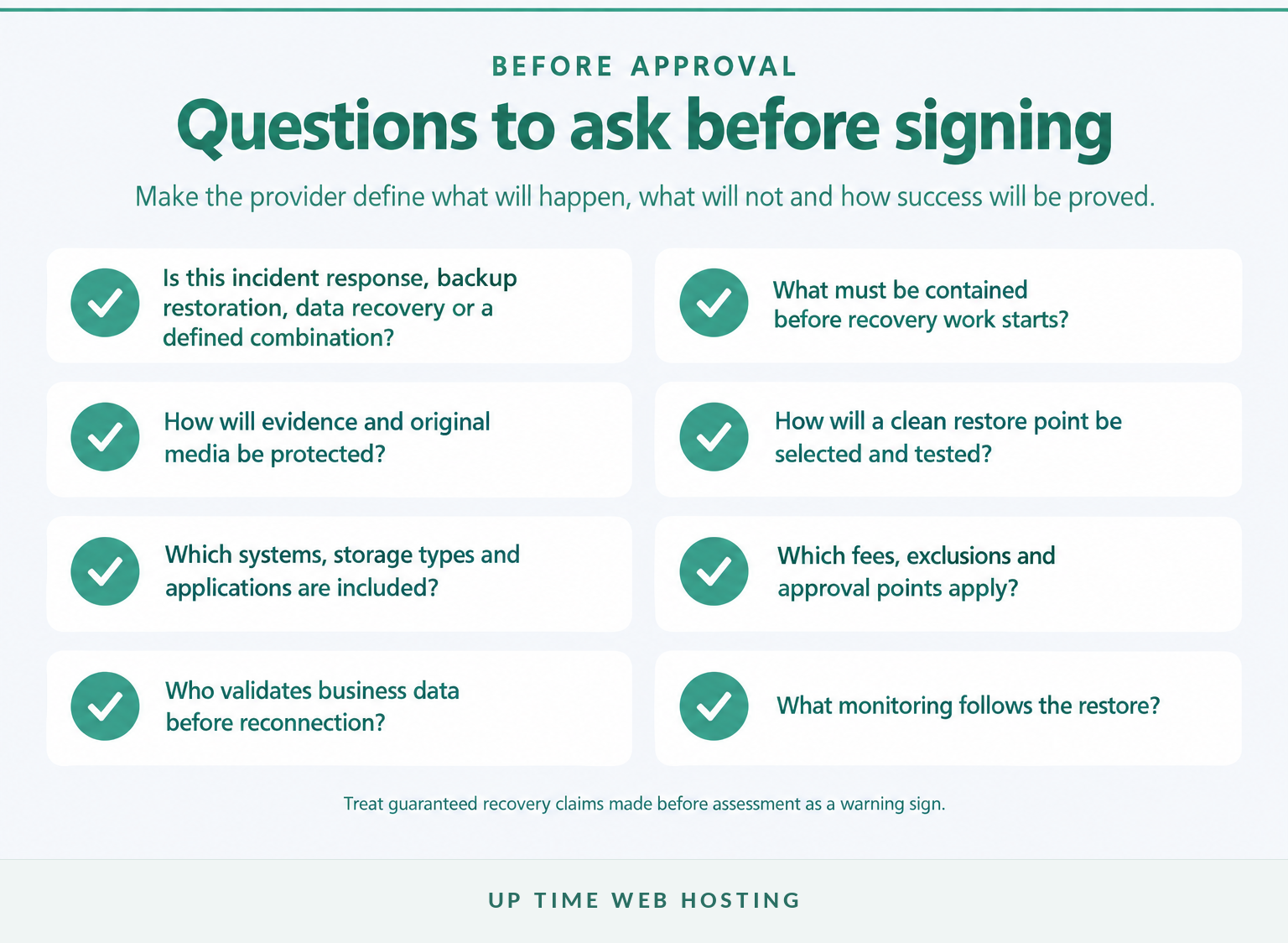
Compare providers by scope, method and proof, not by the shortest promised turnaround. The proposal should state what the provider will contain, preserve, rebuild, restore, validate and exclude.
Ask these questions before approving work:
- What service is this? Confirm whether the engagement covers incident response, forensics, decryption, backup restoration, physical recovery or a defined combination.
- What must happen before restoration? The provider should explain containment, evidence protection and how a clean recovery environment will be established.
- How will the restore point be selected? Ask how the provider determines whether a backup predates the intrusion and remains free from malicious changes.
- Which systems and data types are included? List servers, workstations, cloud services, databases, email, virtual machines, applications and storage devices.
- How will originals be protected? Recovery work should avoid unnecessary changes to original devices, logs and other evidence.
- How will success be measured? Opening several files is not enough. Define application startup, database reconciliation, user testing, security monitoring and business-owner approval.
- What are the costs and approval points? Request a written basis for assessment fees, emergency rates, data transfer, replacement storage, after-hours work and additional recovery attempts.
- What happens if recovery fails? The agreement should explain charges, returned media, retained copies, secure deletion and the next available option.
Treat an unconditional recovery guarantee made before assessment as a warning sign. Other concerns include advice to connect backups immediately, no distinction between restoration and attacker removal, vague confidentiality terms, or a quote that does not name important exclusions.
The best provider explains limits, evidence handling and validation before promising speed.
What should you prepare before an incident?
Prepare the recovery path before an attack by deciding what must be restored, from which protected copy, by whom and within what time. A backup is useful only when the business can access it, restore the required dependencies and validate real work.
The preparation should include:
- An inventory of critical services, data, owners and technical dependencies.
- Approved recovery time and recovery point objectives for each critical service.
- Backups covering data, applications, configuration, keys and recovery documentation.
- Separate backup administration, multi-factor authentication and protection against unauthorised deletion.
- At least one recovery copy that is suitably offline, disconnected or immutable.
- Known-clean administrator access and contact details stored outside the production network.
- Centralised logs and retention suitable for incident investigation.
- A tested privacy, customer, insurer and government reporting process.
ASD’s Essential Eight assessment guide says restoration of data, applications and settings should be tested during regular disaster recovery exercises, at least annually, rather than waiting for the first major incident. (cyber.gov.au)
Recovery controls work best as part of broader small-business cyber security, including patching, access control, multi-factor authentication, monitoring and staff awareness. Prevention will not remove every incident, but it can reduce the number of systems an attacker reaches and the work required to recover them.
Recovery readiness is proved by a tested restore, not a successful backup notification.
Experience Microsoft 365 Business Standard for free for 30 days.
Up to 25 users with full access to email, OneDrive and Teams. Includes full versions of desktop apps of Outlook, Word, Excel, PowerPoint and more.
Try Microsoft 365
What else do businesses ask about ransomware recovery?
These questions usually arise when a business is deciding whether recovery is possible, affordable and safe. The answers below are general guidance; the actual systems, backups and breach scope still need assessment.
Is it possible to recover files from ransomware?
Yes. Files may be recovered from a clean backup, an unaffected snapshot or version history, a verified decryptor, or specialist reconstruction of damaged data stores. Recovery is not guaranteed, and restored data should return only to rebuilt, monitored systems after the attack path and affected scope have been addressed.
How much does it cost to recover data off a hard drive?
Ransomware recovery is not priced like a routine hard-drive job. A quote depends on the number of systems, storage size, urgency, media condition, encryption variant, backup quality, database or virtual-machine work, forensic requirements and after-hours labour. Ask for a written scope, assumptions, exclusions and approval points before work begins.
Can I recover files without paying the ransom?
Yes, sometimes. Clean backups are the preferred path, and a verified free decryptor may exist for a specific ransomware strain. Specialist recovery may also repair or reconstruct some data. The Australian Government advises against paying because payment does not guarantee restoration or prevent stolen information from being leaked or sold. (cyber.gov.au)
What is the average to make a full recovery from a ransomware attack?
There is no useful single average for full ransomware recovery. A small file server with tested clean backups may return far sooner than a multi-site environment with compromised identity systems, damaged backups and a privacy investigation. Measure recovery against each critical service’s approved recovery time and recovery point objectives instead.
No FAQ answer replaces an assessment of the actual systems, backups and breach scope.
What should you do next?
Decide first whether the business needs emergency incident response, specialist file recovery or backup-led restoration. If the incident is active, prioritise containment and evidence now, then choose the recovery path from verified facts.
For ongoing backup design and restoration support across servers, desktops, devices, databases and email, review UpTime Networks backup and recovery services and ask which recovery scope fits the organisation’s systems. An active intrusion may still require a separate forensic incident-response specialist.
Choose the service by the problem you have, not by the word recovery on the provider’s page.