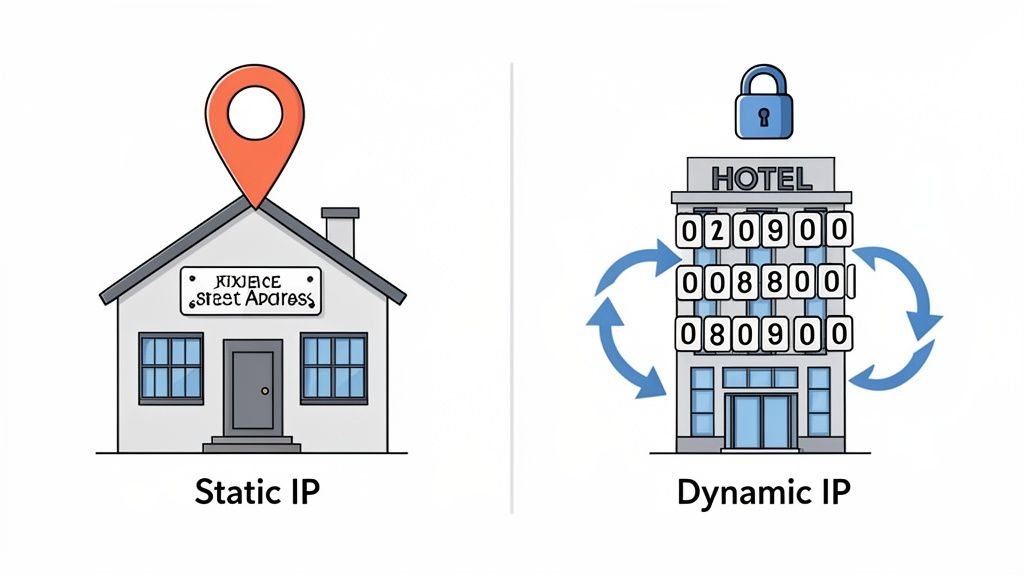
The real difference between a static vs dynamic IP boils down to a simple question: does the address change? Think of a static IP as a permanent, unchanging address for your device—like a fixed street address for your business. A dynamic IP, on the other hand, is a temporary address assigned by your internet provider that changes from time to time, kind of like a hotel room number you only use for your stay.
Understanding the Core Differences
An IP (Internet Protocol) address is just a unique identifier that lets devices find and talk to each other online. It's basically the digital postal address for your computer, server, or even your phone. Every device connected to the internet needs one, but how they get assigned is where things get interesting.
This is where the distinction between static and dynamic becomes crucial for everything from running a website to working remotely.
A static IP address is manually configured and stays put. It's the go-to choice for servers, dedicated business hardware, and any service that needs a reliable, predictable point of contact. Without it, things can get messy fast.
On the flip side, most home and small office networks use dynamic IP addresses. These are automatically handed out from a pool of available addresses by a DHCP (Dynamic Host Configuration Protocol) server. For Internet Service Providers (ISPs), this system is super efficient and cost-effective.
To really get a feel for their roles, it helps to see how their core attributes stack up against each other.
Static vs Dynamic IP At a Glance
The table below breaks down the fundamental differences between a static and a dynamic IP, giving you a quick reference for which one might be right for your situation.
| Attribute | Static IP | Dynamic IP |
|---|---|---|
| Assignment | Manually configured and permanent | Automatically assigned and temporary |
| Typical Cost | Often involves an additional monthly fee | Included with standard internet service |
| Best For | Web hosting, email servers, VPNs, remote access | General web browsing, streaming, home use |
| Reliability | Highly reliable for consistent connections | Generally reliable, but changes can interrupt services |
| Security | Easier to secure via firewalls and whitelisting | Can be harder for attackers to target consistently |
Ultimately, picking the right one comes down to what you’re trying to do.
A static IP offers the stability needed for business-critical applications, making sure services like DNS records work flawlessly. If you've ever run into connection problems, you know how vital this is—you can learn more about what happens when a DNS server is not responding in our detailed guide. For everyday internet use, though, a dynamic IP is a simple, no-fuss solution that works perfectly well.
When a Static IP Is Non-Negotiable
For a lot of businesses, the choice between a static vs dynamic IP is the difference between a reliable online presence and a frustratingly inconsistent one. While a dynamic IP is fine for everyday web browsing, certain business operations absolutely demand the stability that only a fixed, unchanging address can offer.
Think of it as the permanent street address for any service that needs a predictable online location.
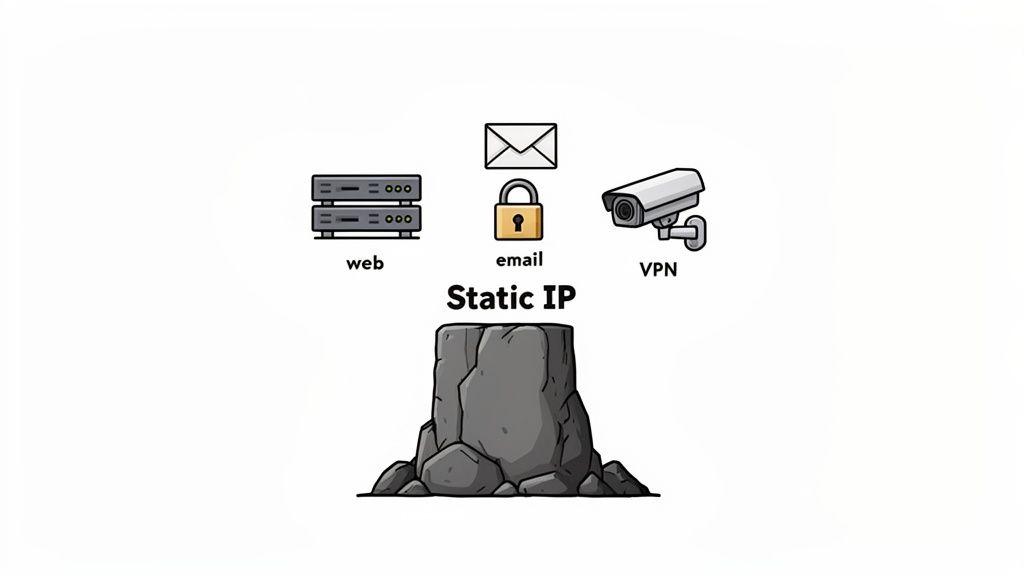
If your business hosts its own website or email server, a static IP isn't just a nice-to-have; it's essential. Your Domain Name System (DNS) records are like a map, pointing your domain name (like yourbusiness.com.au) to your server's IP address. If that address suddenly changes, the map breaks, and customers can no longer find you online.
This kind of digital consistency is the bedrock of a professional online identity.
Powering Essential Business Services
Beyond just hosting a website, several other critical functions lean heavily on a static IP address to work properly. These services are often the backbone of how a modern business runs, making a fixed address a hard requirement, not just a preference.
- Hosting Your Own Web Server: To keep your website accessible to visitors 24/7, its DNS records must point to a permanent IP. A dynamic IP would force you to constantly update these records, leading to downtime and lost traffic.
- Running a Company Email Server: For reliable email delivery, mail servers need a static IP. This helps build a solid sender reputation and stops your important emails from being incorrectly flagged as spam.
- Providing Secure Remote Access: A static IP is vital for setting up a Virtual Private Network (VPN). It gives your remote team a stable, secure endpoint to connect to, which simplifies firewall rules and tightens up security.
A static IP address provides a better fit for DNS servers because it never changes. The DNS server can connect consistently with the same static IP address, resulting in smoother operations and reliable service delivery.
Practical Scenarios and Real-World Examples
Let's say a small business uses security cameras to monitor its office. To check the live feed remotely, the owner needs to connect to the camera system's IP address. With a dynamic IP, that address could change overnight, forcing them to hunt it down every time. A static IP makes sure the connection point is always the same. Simple.
Similarly, a development team needing to give a client access to a staging server can use a static IP for IP allowlisting. By adding the client's static IP to the firewall, they create a secure, private tunnel for access while blocking everyone else. You just can't get that level of control with a constantly shifting dynamic IP.
For businesses that depend on this kind of stability, services like UpTime Web Hosting's cheap VPS hosting plans are a perfect fit. These plans include a dedicated static IP address, providing the reliable foundation needed to run websites, email, and remote access systems without any interruptions. You can see how a fixed address is a key part of a professional setup in our guide on how to properly set up a business email.

Performance you can feel, backed by clients who depend on it. Read how our support and uptime create long‑term customer success.Power Your Business with Better Hosting
Why Most Networks Use a Dynamic IP
If a static IP is so essential for professional services, you might wonder why almost all home networks and small offices end up with a dynamic one. The answer boils down to two simple things: efficiency and cost. For the vast majority of us, a permanent, unchanging IP address just isn't necessary for our day-to-day internet use.
Internet Service Providers (ISPs) are juggling a massive pool of IP addresses, and locking one down permanently for every single customer would be a logistical nightmare. Instead, they rely on a clever system called the Dynamic Host Configuration Protocol (DHCP). You can think of DHCP as an automated traffic controller, handing out a temporary IP address from its available pool every time one of your devices hops online.
The Power of Plug-and-Play
This automatic, 'plug-and-play' setup is perfect for the things most of us do online. Whether you're browsing websites, streaming a movie, checking emails, or working in cloud software like Microsoft 365, your device only needs a temporary address to get the job done. This address might change later, but it all happens seamlessly in the background—you'd never even notice.
From an ISP's perspective, this system is far more practical and cost-effective. It lets them recycle IP addresses, making sure only actively connected devices are using one up. This smart allocation helps prevent the exhaustion of available IPv4 addresses, which are a surprisingly finite resource.
This automatic assignment means you don't need any technical skills to get online. The DHCP server handles everything, making it the most user-friendly and scalable solution for millions of customers.
This is exactly why when you get a new internet connection set up at home or in a small office, you're given a dynamic IP by default. It’s the most sensible solution for anyone who primarily consumes online content rather than hosting their own services. For a deeper dive into the basics, our knowledge base articles on network setup have some great foundational info.
Everyday Dynamic IP Examples
Seeing how a dynamic IP works in the real world makes it clear why it's the standard for most people.
- Home Internet: Your laptop gets one IP when you log on to work from home in the morning. If you disconnect and reconnect later that evening, your ISP's DHCP server might assign you a completely different one.
- Public Wi-Fi: When you connect your phone to the Wi-Fi at your local café, its router assigns your device a temporary, local dynamic IP that's only valid for that session.
- Mobile Data: As you move around during the day, your smartphone is constantly being assigned new dynamic IPs as it connects to different mobile towers.
This flexibility is the real strength of dynamic IP allocation. It provides a simple, zero-maintenance connection that’s perfect for general internet use.
Comparing IP Types for Business Operations
Okay, let's move past the textbook definitions. The real static vs. dynamic IP decision for any business boils down to what you actually do day-to-day. Forget a generic pros and cons list; we need to analyse how each IP type handles specific, real-world business scenarios. This is how you map your company's needs to the right solution.
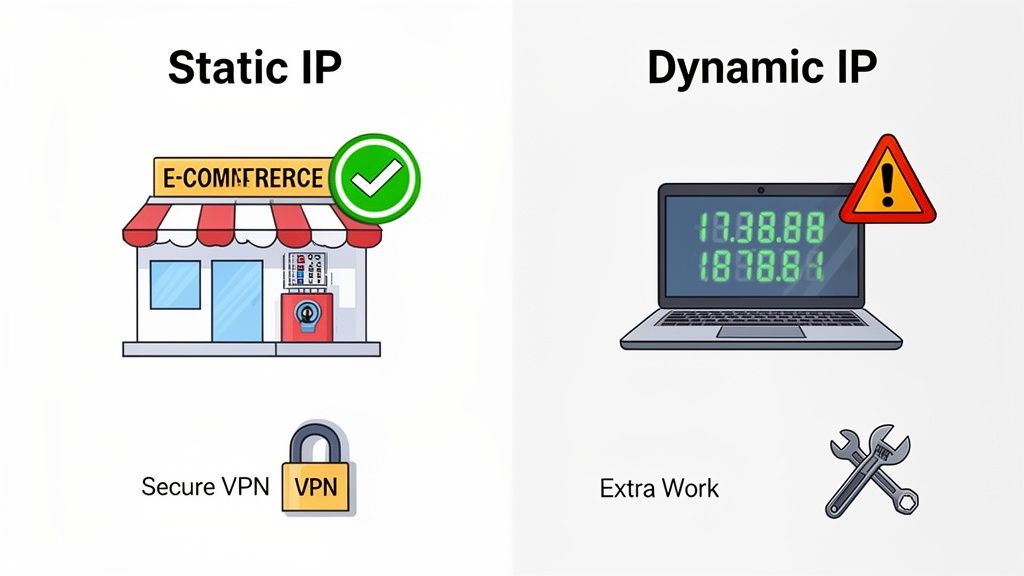
This head-to-head comparison focuses on three pillars of modern business tech: reliability, remote access, and security. Make no mistake, the choice you make here directly impacts everything from your website's uptime to your team's productivity.
Reliability and Website Hosting
For any business hosting its own services, reliability is everything. This is where the difference between a static and dynamic IP becomes crystal clear.
A static IP offers rock-solid stability for an e-commerce site, a customer portal, or any online service you run. Because the address never changes, your DNS records stay accurate, meaning customers and clients can always find you online. That consistency is non-negotiable for maintaining brand trust and avoiding lost sales due to downtime.
On the other hand, a dynamic IP introduces a huge element of risk. If your IP address suddenly changes, your website becomes unreachable until you manually update your DNS records. This can easily lead to hours of downtime, damage your search engine rankings, and create a massively frustrating experience for users. It's simply not a professional look.
Remote Access and Team Collaboration
In today's world of flexible work, giving your team secure and seamless remote access is critical. A static IP address makes this process worlds simpler and far more secure.
With a static IP at your office, you can set up a Virtual Private Network (VPN) that your team can reliably connect to from absolutely anywhere. This fixed address allows you to create super-strict firewall rules, like whitelisting specific IP addresses to ensure only authorised staff can get near sensitive company files.
A dynamic IP makes remote access a recurring headache. Every single time the IP changes, your team's VPN configurations will break. The common workaround is using a dynamic DNS (DDNS) service, but that just adds another layer of complexity and a potential point of failure you don't need.
Security and Network Management
From a security standpoint, the debate has its nuances, but a static IP generally gives you the upper hand. Think of it as a fixed point you can properly fortify. You can implement precise security rules, making it much easier to monitor traffic and spot unusual activity. This level of control is vital for any business that handles sensitive data.
When you're weighing up IP types, getting professional support can make these complex networking decisions much easier. It's worth exploring the advantages of comprehensive managed infrastructure services to see how experts can help lock down your network. This control is especially crucial for solutions like our cheap VPS hosting plans, where a static IP is the foundation for robust server security.
Sure, a dynamic IP offers a tiny bit of obscurity by being a moving target, but this is not a real security strategy. For any serious business application, the stability and control you get with a static IP far outweigh the minor inconvenience of being a fixed target for potential threats.
Host your website with our 5-star rated, cPanel website hosting plans.
Super fast servers, with security included and hosted in your choice of Australian Data Center.
View cPanel Plans
Navigating Cost and Security Trade-Offs
Choosing between a static and dynamic IP is a classic business balancing act. It's about weighing up a small monthly cost against some serious long-term security gains. As with any decision, what you save in dollars upfront, you might end up paying for later in complexity or vulnerability.
For any Australian business, this isn't just a hypothetical choice; it's a practical calculation. Look at the local NBN and business broadband market. Most ISPs will happily give you a dynamic IP at no extra cost, but a static IP is almost always sold as a premium business feature. You can expect to pay anywhere from AUD $5 to $20 per month on top of your plan.
When you consider that Australian businesses lost an estimated $3.1 billion to cybercrime in 2022–23, that small monthly fee for a static IP starts to look less like an expense and more like a very smart investment in your company's security.
The Financial Side of the Equation
At first glance, sticking with a free dynamic IP seems like a no-brainer for saving cash. Since they’re automatically dished out from a shared pool, ISPs don’t charge for them. But this initial saving can quickly be wiped out by hidden costs down the track.
If you rely on things like a VPN for remote access or you host your own services, a dynamic IP can become a real headache. The time and money spent troubleshooting why the VPN connection suddenly dropped—all because the IP address changed overnight—can easily eclipse the cost of a static IP for the month. To get a bigger picture, understanding broader cloud cost optimization strategies can help put these kinds of infrastructure decisions into a clearer financial context.
Security: A Double-Edged Sword
When it comes to security, a static IP presents an interesting paradox. Because the address never changes, it becomes a fixed, predictable target for anyone trying to launch an attack. That sounds like a big problem, but it’s also its greatest strength.
A fixed IP address allows you to create highly specific and strict security policies. You can build a digital fortress around a known location, which is impossible with a constantly moving target.
This opens up a whole suite of powerful security measures you just can't implement effectively with a dynamic IP:
- IP Whitelisting: This is a big one. You can configure your firewall to only accept connections from specific, trusted static IPs, like your main office or key remote staff. It’s a simple way to instantly block unwanted access from anywhere else in the world.
- Enhanced Monitoring: With a consistent address, spotting suspicious activity in your traffic logs becomes much, much easier. Any unusual connection attempts stand out like a sore thumb instead of getting lost in the noise.
- Geofencing: You can lock down access to your digital assets to specific geographic regions. This is a crucial step for any business concerned with data sovereignty. In fact, thinking about where your data lives is key, which is why hosting your website in Australia is such a critical part of a solid security strategy.
Sure, a dynamic IP offers a tiny bit of anonymity because it changes, but "security through obscurity" is not a real defence strategy. For any serious business, the control and fortification you get from a static IP is far more valuable. Partnering with a provider like UpTime Web Hosting means you get these enterprise-grade security benefits without having to manage all the complexities yourself.
How to Choose the Right IP for Your Business
Making the final call between a static and dynamic IP really boils down to what your business actually does every day. It's a decision where cost, security, and operational reliability all have to meet in the middle. To take the guesswork out of it, let's map some common business scenarios to the right IP type.
This simple decision tree is a great way to visualise the key trade-offs, zeroing in on the cost and security angles.
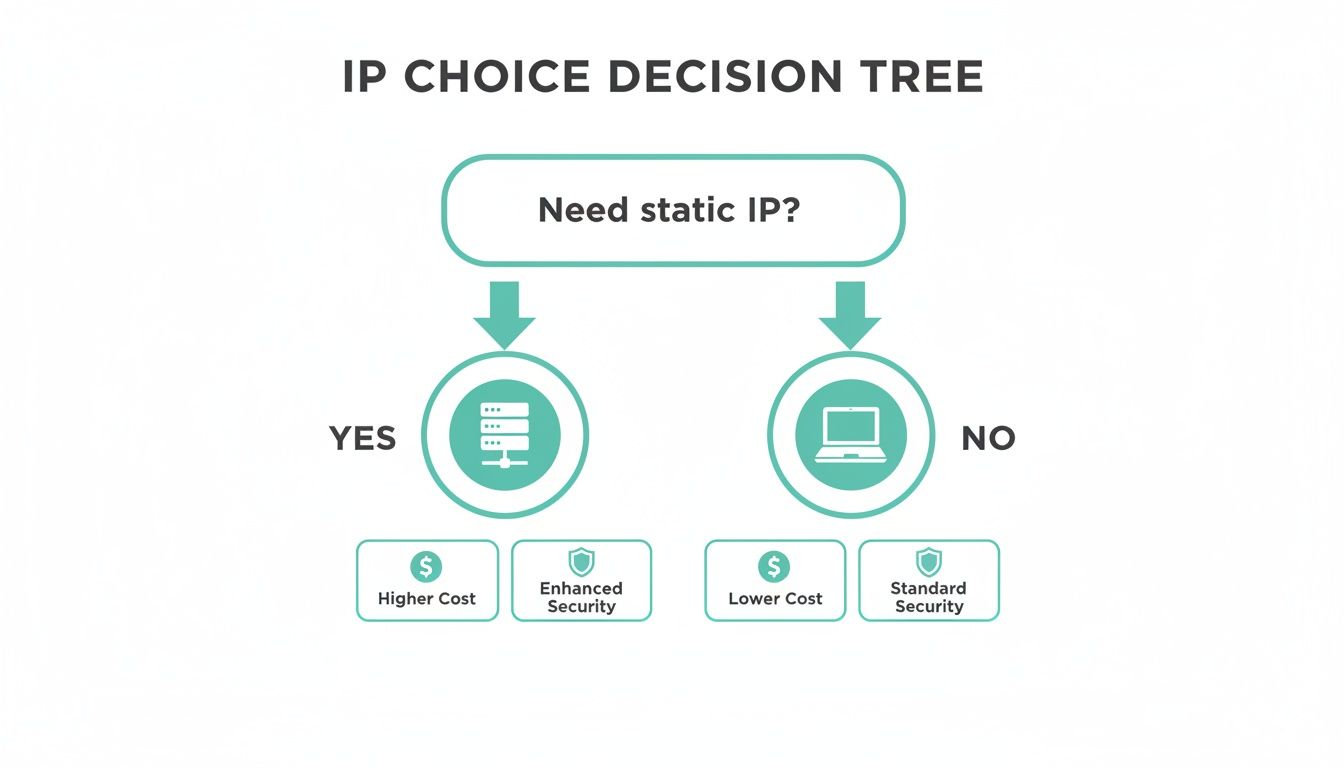
As you can see, while a dynamic IP is the standard, cheaper option for general use, a static IP brings a critical layer of stability and security that is essential for more professional applications.
Your Business IP Recommendation Matrix
To make this even clearer, this handy matrix connects your primary business activities to the most suitable IP address type.
| Business Use Case | Recommended IP Type | Key Reason |
|---|---|---|
| Running a Web or File Server | Static IP | Your server needs a permanent, findable address for DNS records to work and for users to connect consistently. |
| Managing a Remote Team via VPN | Static IP | A fixed address is vital for stable VPN connections and for creating strict, secure firewall access rules. |
| General Office Internet Use | Dynamic IP | For everyday browsing, cloud apps, and checking emails, a dynamic IP is perfectly sufficient and more cost-effective. |
| Hosting a Company Email Server | Static IP | A static IP is crucial for building a solid sender reputation and preventing your business emails from being flagged as spam. |
At the end of the day, the right choice often comes down to one simple question:
Do you need external services or people to reliably connect to your network? If the answer is yes, a static IP is almost always the correct business decision.
How to Get a Static IP
If you've realised a static IP is the way to go, getting one is usually quite straightforward. Most Australian internet providers offer static IPs as a paid add-on for their business plans. It's typically as simple as giving them a call and requesting it.
For those needing more control and power, another great option is a Virtual Private Server (VPS) from UpTime Web Hosting. A dedicated static IP address is included by default with our VPS plans. This gives you the perfect foundation for hosting websites or applications, guaranteeing maximum reliability and security from the get-go.
And if you're hosting your own mail server, it's worth checking out our guide on how to set up a business email to make sure you're following best practices. This will help you build a professional and dependable setup right from day one.
Got Questions About IP Addresses? We’ve Got Answers.
We've walked through the main differences between static and dynamic IPs, but a few common questions always pop up. Let's clear up any lingering confusion you might have.
Can I Host a Website With a Dynamic IP?
Technically, you can, but for any serious business, it's a recipe for disaster. A dynamic IP address changes whenever it feels like it, which means your website's DNS records will constantly point to the wrong place.
The result? Your site will frequently be offline. This leads to lost traffic, frustrated customers, and a real blow to your brand's reputation. If you want reliable hosting, a static IP isn't just a good idea—it's essential.
Does a Static IP Make My Internet Faster?
This is a common myth, but the short answer is no. Your internet speed is determined by the plan you have with your ISP, not the type of IP address you use.
The real benefit of a static IP is its stability. It gives you a permanent, unchanging address for reliable connections to your network, but it won't give your download or upload speeds a boost.
How Do I Get a Static IP for My Business?
Getting a static IP is usually pretty straightforward. The most direct route is to simply contact your Internet Service Provider (ISP) and ask for one. Most Australian NBN providers offer static IPs as a paid add-on for their business internet plans.
Another great option is to choose a hosting service that includes one from the get-go. For instance, our UpTime Web Hosting Virtual Private Server (VPS) plans all come with a dedicated static IP. This gives your website or application a professional, stable foundation right out of the box.
Ready to build your business on a stable, secure foundation? UpTime Web Hosting offers powerful hosting solutions with dedicated static IPs included. Explore our reliable Australian hosting plans today!