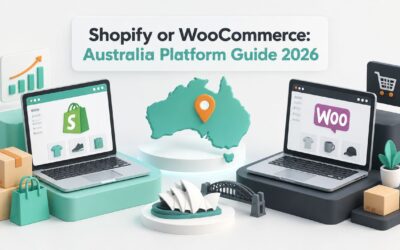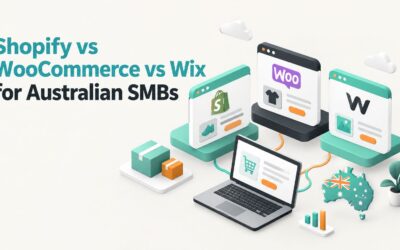
Australian online retail has shifted decisively towards platform-led selling. One 2026 store-count dataset estimates 153,140 Shopify stores in Australia compared with 82,481 WooCommerce stores, giving Shopify roughly a 1.9-to-1 lead in active stores. The Australian platform data doesn't prove that Shopify suits every business, but it does show why the old assumption that WooCommerce and Shopify are evenly matched locally needs a fresh look.
The practical choice is straightforward. Shopify trades control for managed infrastructure and a faster launch. WooCommerce trades simplicity for ownership, flexibility and hosting choice. Australian conditions make that trade-off more important because GST-inclusive pricing, local payment costs, Australian hosting performance and marketplace traffic all affect the operating result.
| Decision area | Shopify | WooCommerce |
|---|---|---|
| Platform model | Hosted ecommerce service | Self-hosted WordPress ecommerce plugin |
| Best operational fit | Fast launch, lean teams, managed infrastructure | Custom requirements, WordPress users, hands-on operators |
| Hosting | Included in the platform | Chosen and managed separately |
| Checkout | Shopify-managed checkout | Checkout controlled through WordPress, themes and extensions |
| Customisation | Strong within Shopify's ecosystem | Extensive control across WordPress and WooCommerce |
| Cost pattern | Predictable plan plus apps and payment costs | Variable hosting, extensions, maintenance and payment costs |
| Australian priority | Reduce technical overhead | Control local hosting and implementation |
Table of Contents
- Australian Ecommerce Platform Picture in 2026
- True Cost of Running Each Platform in Australia
- Checkout Performance and Hosting Control Compared
- The Marketplace Shift Most Comparisons Ignore
- Launch Workflow and Setup Experience for Australian Merchants
- Decision Framework for Australian Business Types
- Real Australian Merchant Scenarios and Outcomes

Performance you can feel, backed by clients who depend on it. Read how our support and uptime create long‑term customer success.Power Your Business with Better Hosting
Australian Ecommerce Platform Picture in 2026
Australian store counts now favour Shopify, although WooCommerce remains a serious local option. One Australia-focused snapshot recorded 117,625 Shopify stores, or 35.41%, compared with 106,237 WooCommerce stores, or 31.98%. Earlier reporting put WooCommerce ahead, with a 2020 comparison citing 34.38% market share, while a 2022 summary placed Shopify at 31% and WooCommerce at 27%. The direction is clear: Australia has shifted from a WooCommerce lead towards a Shopify advantage.
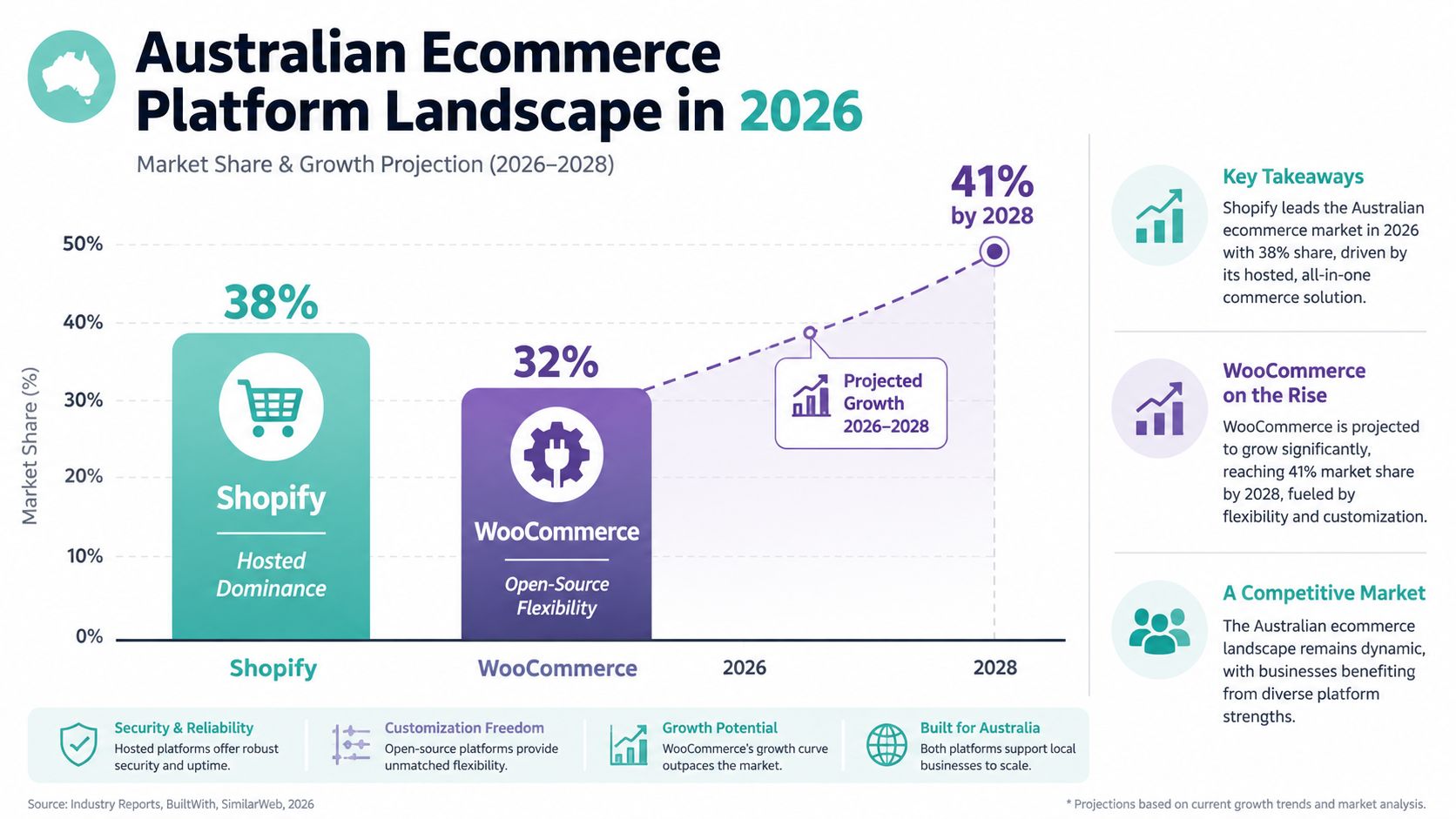
That shift changes the commercial decision. Platform choice determines who handles hosting, security updates, checkout infrastructure, integrations and technical faults. Shopify manages most of that through its hosted service. WooCommerce puts more responsibility on the merchant or agency, while providing greater control over code, servers, local performance and the customer journey.
The market is bigger than the storefront
Australian shoppers increasingly buy through channels beyond brand-owned websites. Australia Post reports that marketplace transactions grew 17% year on year, with marketplaces representing 23% of Australian online spend in 2025, or A$18.9 billion. The platform decision therefore concerns channel operations, not only design or plugins.
A marketplace, social campaign or product video may bring in the first order. The merchant's own website then needs to turn that customer into a repeat buyer, capture consented customer data and protect margin. Resources such as trending product videos show how product-led content can support that path, while the site still needs a dependable checkout.
Hosted versus self-hosted is the core divide
Shopify is the sensible default for an owner who wants to sell without becoming the website administrator. WooCommerce suits an existing WordPress site, a complex content model or a customised customer journey that warrants technical ownership.
Self-hosted merchants should review online selling in Australia hosting requirements before selecting a plan. Australian server location, caching, backups and support response can affect the customer experience more than the platform label itself. Choose Shopify to reduce operational overhead. Choose WooCommerce when control justifies the additional responsibility.
True Cost of Running Each Platform in Australia
WooCommerce is free software, not a free online store. The budget includes hosting, a domain, security, backups, payment integrations, themes, extensions and technical support. Shopify charges a subscription, but hosting, SSL and platform scaling are included, so fewer separate services need to be managed.
Shopify's Australian plans are listed at about AUD 56 per month for Basic, followed by roughly AUD 149 and AUD 575 tiers, with Plus priced by quotation. Its published comparison also says the Shopify checkout outperformed WooCommerce's checkout by 17% in a global study. Treat that as a platform claim, not a guaranteed result for every Australian store. The detailed comparison is available in Shopify's Australian comparison.
WooCommerce has a wider cost range. Australian comparison material places hosting around AUD 15 to AUD 50 per month, while a broader hosting and plugin budget sits closer to AUD 30 to AUD 120 per month. Shopify is commonly estimated at AUD 49 to AUD 399 or more per month, depending on the plan and add-ons. The Australian cost comparison from Alinga is useful because it separates the cost drivers from the free plugin headline.
Monthly operating cost comparison
| Cost Component | WooCommerce (AUD/month) | Shopify (AUD/month) |
|---|---|---|
| Platform software | WooCommerce plugin is generally free | About AUD 56 for Basic, with higher tiers around AUD 149 and AUD 575 |
| Hosting | About AUD 15 to AUD 50, or more for a stronger stack | Included |
| SSL | Depends on hosting arrangement | Included |
| Plugins and apps | Variable, often AUD 30 to AUD 120 when practical hosting and plugin costs are combined | Add-ons can increase the monthly total |
| Theme | Free or paid, depending on the storefront | Free or paid, depending on the storefront |
| Maintenance | Merchant, agency or hosting arrangement | Mostly managed by Shopify |
| Payment processing | Gateway fees apply | Shopify Payments or third-party gateway costs apply |
| GST planning | Configure pricing and tax settings in WooCommerce | Configure Australian tax settings in Shopify |
GST must be handled consistently across both platforms. Your advertised price, tax settings, invoices and accounting workflow should agree. A hosting invoice compared with a Shopify subscription is not a total-cost analysis. Add extensions, support time, maintenance and payment processing to the calculation.
Where the cheaper option changes
WooCommerce can cost less for a small catalogue when the merchant already has WordPress, understands the technical setup and needs few extensions. The calculation changes when the owner pays developers to fix plugin conflicts, repair failed updates or address a slow store.
Shopify offers a more predictable base cost. That predictability suits a solo owner who cannot afford technical interruptions, although app subscriptions and third-party payment arrangements can still raise the monthly bill. WooCommerce owners can use this guide to annual web hosting costs to assess hosting separately from the wider store budget.
Budget rule: Choose WooCommerce for the lower entry cost only if someone accepts responsibility for the technical work. Choose Shopify when reducing that responsibility justifies the recurring platform cost.
Host your website with our 5-star rated, cPanel website hosting plans.
Super fast servers, with security included and hosted in your choice of Australian Data Center.
View cPanel Plans
Checkout Performance and Hosting Control Compared
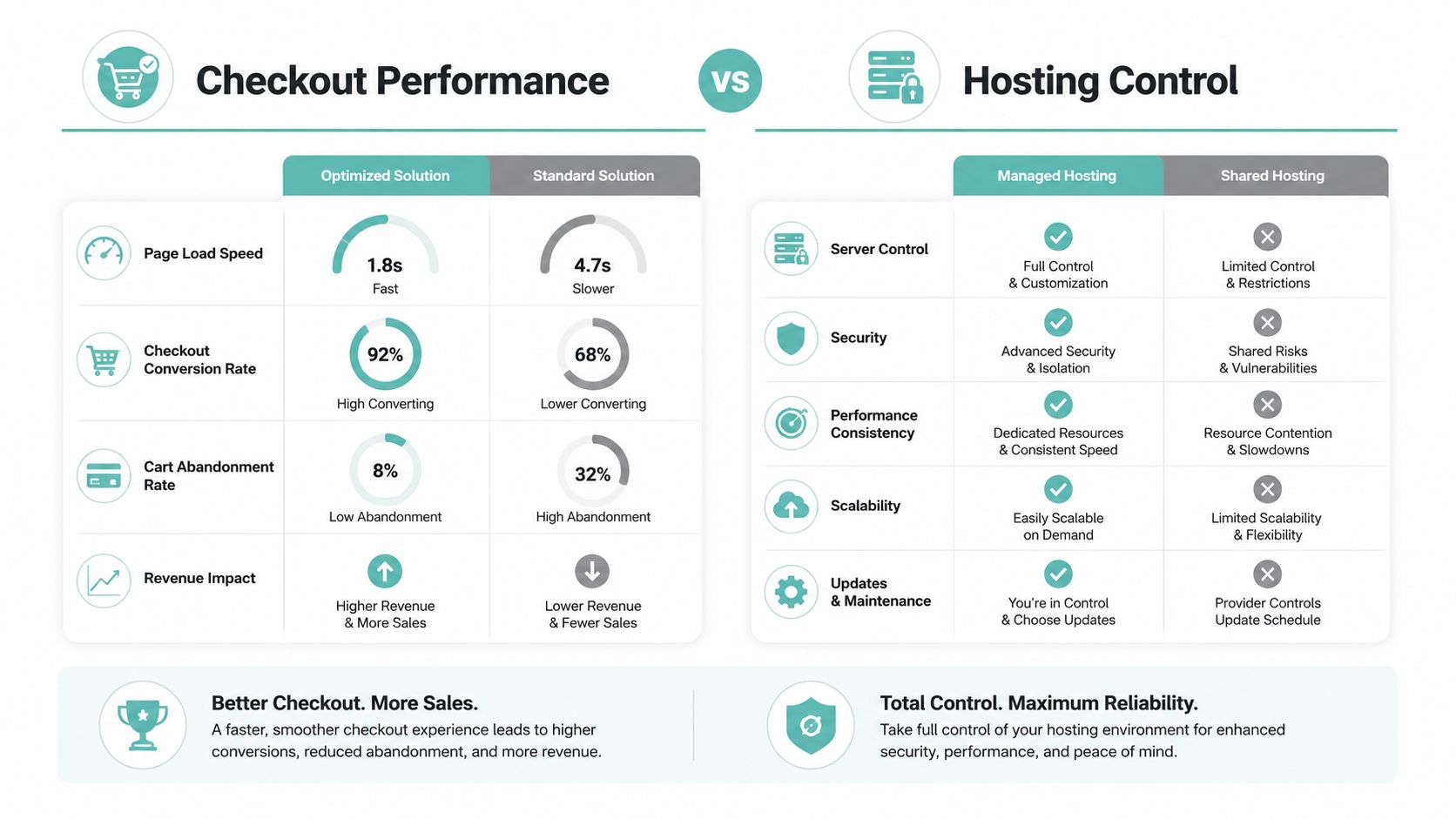
Checkout performance directly affects revenue. A polished catalogue cannot compensate for a checkout that loads slowly, fails on mobile or creates payment friction. Shopify reports that its checkout performed 17% better than WooCommerce's checkout in a global study. Treat that result as a benchmark, not an Australian guarantee. Test the actual theme, apps, payment methods and devices your customers use, as outlined in Shopify's comparison.
Shopify removes infrastructure decisions
Shopify hosts the store, supplies SSL and manages the platform layer. You do not choose the server stack, patch the core system or tune the database after a campaign creates an unusual traffic spike. That suits Australian merchants preparing for EOFY promotions, product launches or Black Friday activity without an internal technical team.
The trade-off is control. Your store operates within Shopify's checkout architecture, theme system and app ecosystem. Standard Australian retail requirements usually fit the platform, while unusual pricing logic, customised fulfilment flows or specialised B2B processes may require apps or a different implementation.
WooCommerce makes hosting part of the product
WooCommerce performance depends on hosting, WordPress configuration, database health, image sizes, caching and the number and quality of installed plugins. Australian merchants can choose local infrastructure and tune the stack for local visitors, but someone must manage that work.
The guide to WooCommerce hosting explains why an online store needs more than brochure-site hosting. A suitable Australian setup should cover caching, backups, malware protection, database performance and support, rather than storage capacity alone.
Operational test: Ask who will respond when checkout fails during a campaign. If nobody owns that response, Shopify is safer than a highly customised WooCommerce stack.
Sydney, Melbourne, Brisbane or Perth infrastructure can help Australian audiences because server distance affects the delivery path. Local hosting will not repair oversized images, a bloated theme or inefficient plugins, but it gives WooCommerce operators a practical performance control. Shopify provides consistency instead, with fewer infrastructure decisions to manage.
The Marketplace Shift Most Comparisons Ignore
The standard WooCommerce versus Shopify debate starts with the assumption that shoppers arrive at the store. Australian buying behaviour challenges that assumption. Marketplaces accounted for 23% of online spend in 2025, worth A$18.9 billion, while marketplace transactions grew 17% year on year, as noted earlier in the Australia Post's ecommerce report.
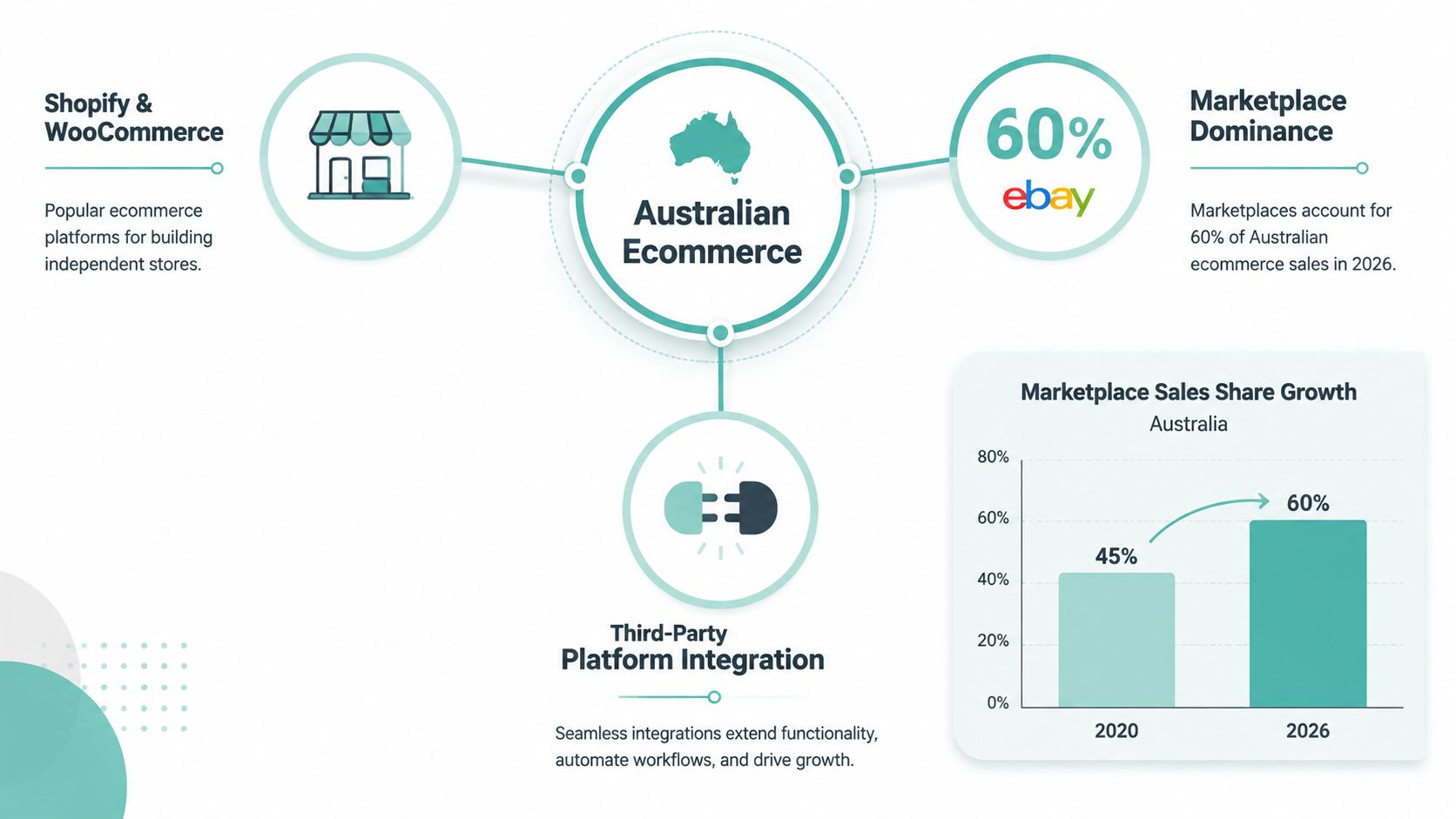
The practical question is, “What happens after a customer discovers me somewhere else?” A marketplace can create initial demand, while the owned store handles brand education, bundles, repeat purchases, email capture and products that do not suit the marketplace catalogue.
Build around the channel mix
Shopify is usually the cleaner choice for a merchant that wants one central catalogue, managed connections and a consistent operating process. WooCommerce is stronger when the store must connect closely with WordPress content, a custom catalogue, specialist fulfilment or an existing business system.
Neither platform removes marketplace work. Stock must stay synchronised, product information must match, shipping rules must remain clear and orders from each channel need defined handling. A failed stock update can cause overselling, customer service work and margin pressure regardless of the storefront technology.
Scale and operating complexity should guide the decision. Merchants assessing larger ecommerce environments can review enterprise platform cost and performance for a wider view of infrastructure and commercial trade-offs, although an SMB may not need an enterprise implementation.
Convert referred traffic properly
A customer referred from a marketplace may not recognise or trust the standalone store. Match the landing page to the discovery channel, including the product name, imagery, price logic and delivery promise. Show GST clearly, support Australian payment expectations and keep account creation out of the way unless it serves a clear purpose.
Use this guidance for selling products online in Australia to map the store's channel, hosting and fulfilment requirements. Hosting affects local performance, while fulfilment determines whether marketplace demand becomes profitable repeat business.
The strongest store is not the one with the most custom features. It is the one that turns borrowed attention into a dependable customer relationship.
Launch Workflow and Setup Experience for Australian Merchants
Shopify's Australian site reduces launch to a guided sequence: add a first product, customise the store and set up payments. Shopify Australia presents that workflow directly, and it suits a merchant who wants to move from an idea to a testable storefront without assembling a separate WordPress environment.
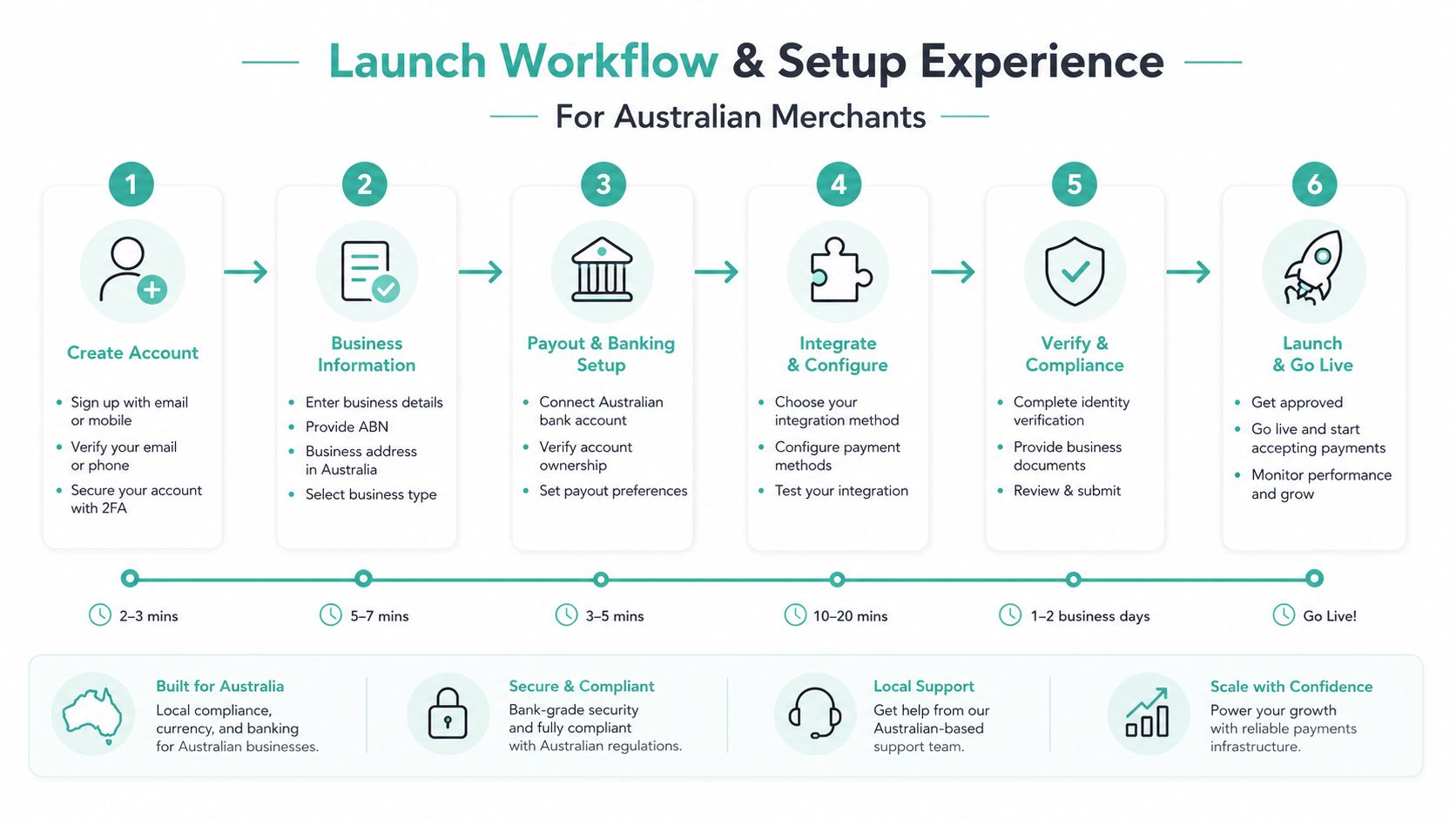
Shopify launch sequence
- Register the domain. Choose a suitable .au domain and make sure the legal business name, brand and customer-facing URL align.
- Add products. Enter GST treatment, product descriptions, images, variants, stock and delivery information before inviting customers.
- Select the theme. Keep the first version focused on navigation, mobile readability and a clear add-to-cart path.
- Configure payments. Connect Shopify Payments where appropriate, then test Australian cards and any supported buy-now-pay-later options your customers expect, such as Afterpay or Zip.
- Set shipping. Create domestic zones, delivery rates, pickup rules and any international destinations you can service profitably.
- Test the full order. Place a test order on mobile, check the tax display, payment confirmation, fulfilment notification and refund process.
Shopify's Australian support contact and Help Center resources provide guides, FAQs and a virtual Help Center assistant. That gives a new owner a defined place to start when a setup question appears.
WooCommerce needs more assembly
WooCommerce begins with WordPress hosting, a domain, SSL, WordPress, the WooCommerce plugin and the extensions needed for payments, shipping and tax. The explanation of what WooCommerce is is a useful starting point for owners deciding whether they want to manage that foundation.
A pre-configured Australian hosting environment can shorten the technical work, but it doesn't remove decisions. You still need to select a theme, review plugin compatibility, configure GST-inclusive display, connect payment providers, set delivery zones and establish backups. Test every extension together, not just in isolation.
Don't launch from the admin screen alone
Check the store as a customer in different browsers and on a phone. Verify that a product with GST included displays the intended price, that shipping doesn't erase margin, that payment success sends the right confirmation and that a failed payment gives the customer a clear recovery path.
Register your new domain name at competitive market prices including free domain add-ons like privacy, DNS Hosting, Custom Nameservers and Forwarding.
Always the best price and no nasty renewal price hikes.
Register A Domain Name
Decision Framework for Australian Business Types
The best answer to WooCommerce vs Shopify depends on who will operate the store after launch. A platform that suits a developer-led brand can burden a solo owner, while a managed platform can frustrate a business whose sales process depends on unusual catalogue logic.
Match the platform to the operator
| Australian business type | Recommended platform | Reason |
|---|---|---|
| Solo entrepreneur launching a first store | Shopify | Guided setup and less infrastructure administration |
| Small retailer with WordPress skills | WooCommerce | Lower entry cost and broader control |
| Scaling brand prioritising managed operations | Shopify, with an enterprise discussion when justified | Consistent infrastructure and reduced maintenance |
| Custom-first developer or agency | WooCommerce | Greater access to code, data and checkout logic |
A solo entrepreneur should choose Shopify unless there's a strong reason to stay in WordPress. The owner can focus on product quality, customer acquisition and fulfilment instead of troubleshooting hosting and plugin updates.
A small retailer with an established WordPress site should consider WooCommerce. The business can keep its content structure, use local hosting and add ecommerce without splitting the customer experience across separate systems. That choice only works if the owner or agency schedules maintenance.
Complex catalogues need a technical decision
WooCommerce is the better fit for custom pricing, unusual product relationships, specialist B2B catalogues and checkout requirements that don't fit standard workflows. Shopify is the better fit when the catalogue and checkout are conventional but the team wants reliable operations with fewer moving parts.
Agencies should make the choice based on repeatability. Shopify can simplify standard client builds and support, while WooCommerce can provide a reusable WordPress framework for clients needing deep content or integration work. Document the maintenance burden before promising a low project price.
For broader thinking about a content management system for small business, compare the store with the rest of the organisation's content and marketing needs. A store isn't separate from the website strategy.
My recommendation
Choose Shopify if speed, operational simplicity and managed infrastructure matter most. Choose WooCommerce if control, customisation and local hosting choice matter more than convenience.
A managed Australian host such as UpTime Web Hosting offers WordPress and WooCommerce hosting with local infrastructure, security features, backups and support options, which can make WooCommerce more practical for a merchant who wants control without managing every server task alone.
Real Australian Merchant Scenarios and Outcomes
A Melbourne homewares brand moving from market stalls to online selling probably doesn't need a custom checkout. The owner needs to add products quickly, show GST-inclusive prices, connect familiar Australian payment options and manage domestic delivery without becoming a WordPress administrator. Shopify is the practical recommendation because the business can spend its limited time on photography, stock and customer service.
A Sydney digital agency managing 20 client stores needs a different operating model. If most clients need standard catalogues and straightforward checkout, Shopify can reduce variation across builds and make support procedures easier to standardise. If the agency's clients already depend on WordPress publishing, custom integrations or specialist catalogue logic, WooCommerce gives the developers more room to build reusable solutions.
A Brisbane manufacturer selling B2B through a detailed catalogue should start with requirements, not a theme. Account-specific pricing, quote requests, trade customers, product specifications and links to internal systems can push the decision towards WooCommerce, particularly when developers need direct control over the customer journey. Shopify remains suitable if the manufacturer can express those requirements through its supported tools without compromising the sales process.
Australia's online retail market continues to expand. NAB estimated A$64.88 billion in online retail spending in the 12 months to July 2025, up 13.9% year on year, while KPMG reported A$13.8 billion in online spending during the June quarter of 2025 and online retail at 12.2% of total turnover. NAB's Online Retail Sales Index provides the relevant figures. The opportunity is real, but the platform should support your margins and operating capacity, not merely look impressive in a comparison chart.
If you're choosing WooCommerce, UpTime Web Hosting provides Australian WordPress and WooCommerce hosting with local infrastructure, security tools, backups and support options. Visit UpTime Web Hosting to review a hosting setup that can give your store more control without leaving performance and maintenance to chance.