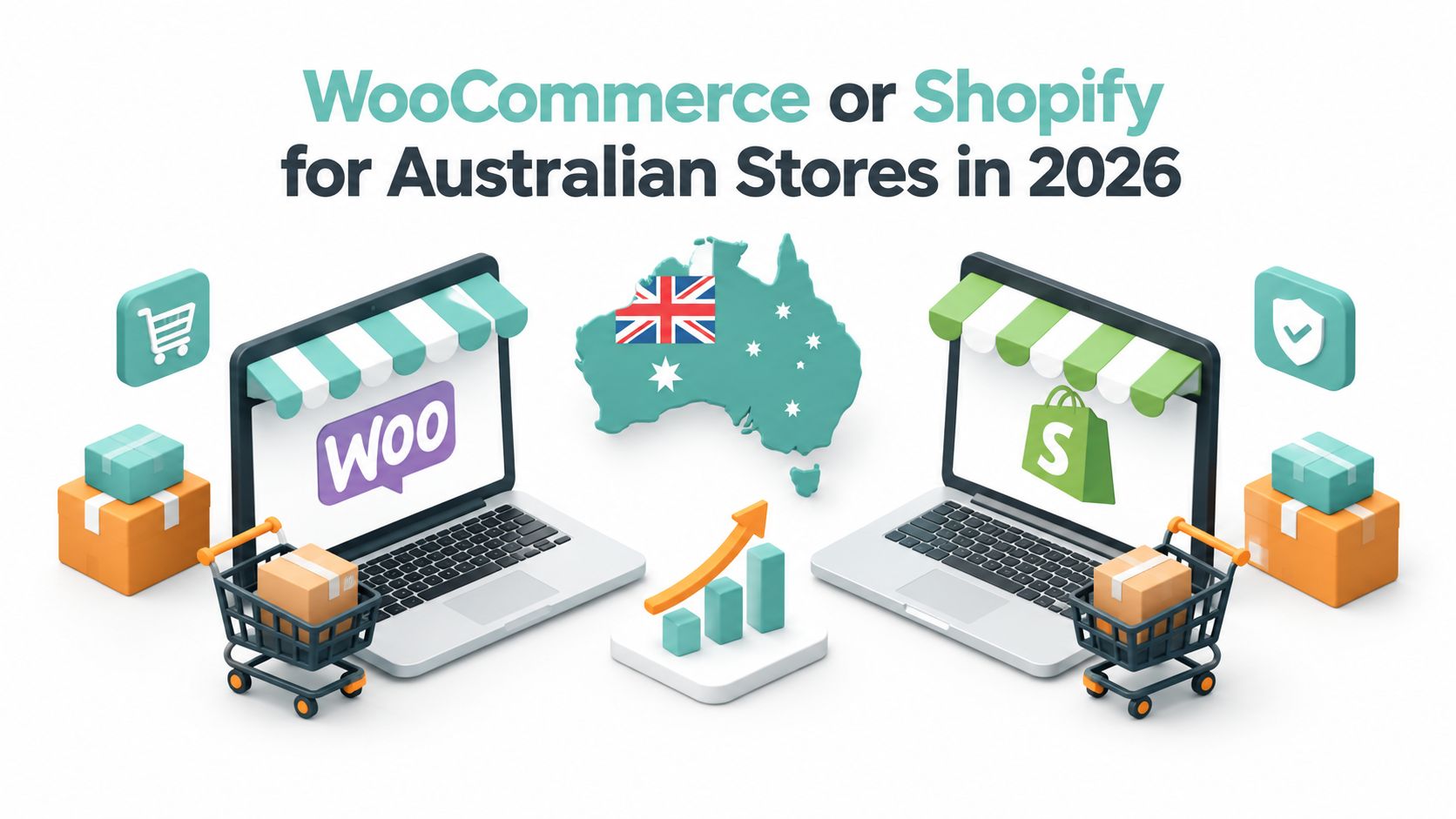
You're probably in the same spot most Australian store owners hit sooner or later. Sales are coming through social, email, marketplaces, or a clunky old website. You need a proper online store now, not in six months. You also don't want to pick the wrong platform, discover the costs later, and spend the next year patching around that decision.
That's why the WooCommerce or Shopify question matters more than people admit. It isn't just about design templates or whether one dashboard feels cleaner. It's a decision about how you want to run the business. Who handles hosting. Who handles updates. How much control you keep. How GST shows up on bills and fees. How painful custom workflows become once your catalogue, shipping rules, and marketing stack get more complicated.
I've seen this play out with local businesses in very ordinary situations. A Brisbane retailer wants to launch before a sales campaign and values speed over flexibility. A Sydney wholesaler already runs WordPress and needs account-specific pricing, content, and lead capture in one place. A Melbourne founder starts with “cheap and simple” in mind, then realises the store also needs email capture, local fulfilment rules, subscriptions, and better search. The platform decision changes once you factor in the full operating model.
For Australian SMBs, that's the only sensible way to compare WooCommerce and Shopify in 2026. Don't ask which one is cheaper on day one. Ask which one stays sensible after payment fees, GST treatment, hosting, maintenance, app spend, and day-to-day management are part of the picture.
Table of Contents
- Introduction Why This Choice Matters for Australian Businesses
- How WooCommerce and Shopify Work at a Glance
- Total Cost of Ownership in Australia
- Hosting Performance Security and Everyday Control Compared
- Which Platform Fits Your Business Model Best
- Deploying Your Store the Australian Way
- Final Recommendation and Next Steps for Your Decision

Performance you can feel, backed by clients who depend on it. Read how our support and uptime create long‑term customer success.Power Your Business with Better Hosting
Introduction Why This Choice Matters for Australian Businesses
Australian merchants don't buy software in a vacuum. You're dealing with shipping expectations, thinner margins, support limitations, and customers who are watching value closely. That changes the answer.
The common mistake is treating Shopify as the “easy” option and WooCommerce as the “technical” one, then stopping there. That's too shallow. A platform can be easy to start and still expensive to operate. Another can be harder to set up but cheaper and more adaptable once the store has real complexity.
The decision usually starts with urgency
A lot of businesses begin with a practical problem, not a strategy workshop.
- The old site can't sell properly. Product pages are hard to manage, checkout feels dated, and marketing keeps sending traffic to a weak buying experience.
- The business has outgrown a simple setup. Manual invoices, custom shipping workarounds, and fragmented plugins start wasting staff time.
- The owner wants clarity. They need a platform that won't punish growth or force a rebuild when the business adds new product lines, content, or fulfilment processes.
If that's where you are, you don't need a generic feature checklist. You need a platform that matches the way your business operates in Australia.
Practical rule: choose the platform you can still live with once payments, shipping, GST, support, and maintenance become recurring operational costs, not one-off setup decisions.
What matters more than the monthly plan
A monthly subscription is only one line item. The question is what sits around it.
For Shopify, that usually means convenience, an all-in-one setup, and predictable administration. For WooCommerce, it usually means more ownership, more hosting choice, and more responsibility for keeping things tuned and secure.
Neither is automatically better. But one will usually fit your business model better than the other.
The businesses that make the best choice tend to focus on four issues first:
- Total cost of ownership. Not just startup cost.
- Operational control. Especially around content, custom workflows, and integrations.
- Performance in Australian conditions. Including hosting choices and local support realities.
- Internal capability. Whether your team can manage a flexible stack or needs guardrails.
How WooCommerce and Shopify Work at a Glance
Shopify and WooCommerce solve the same problem in different ways.
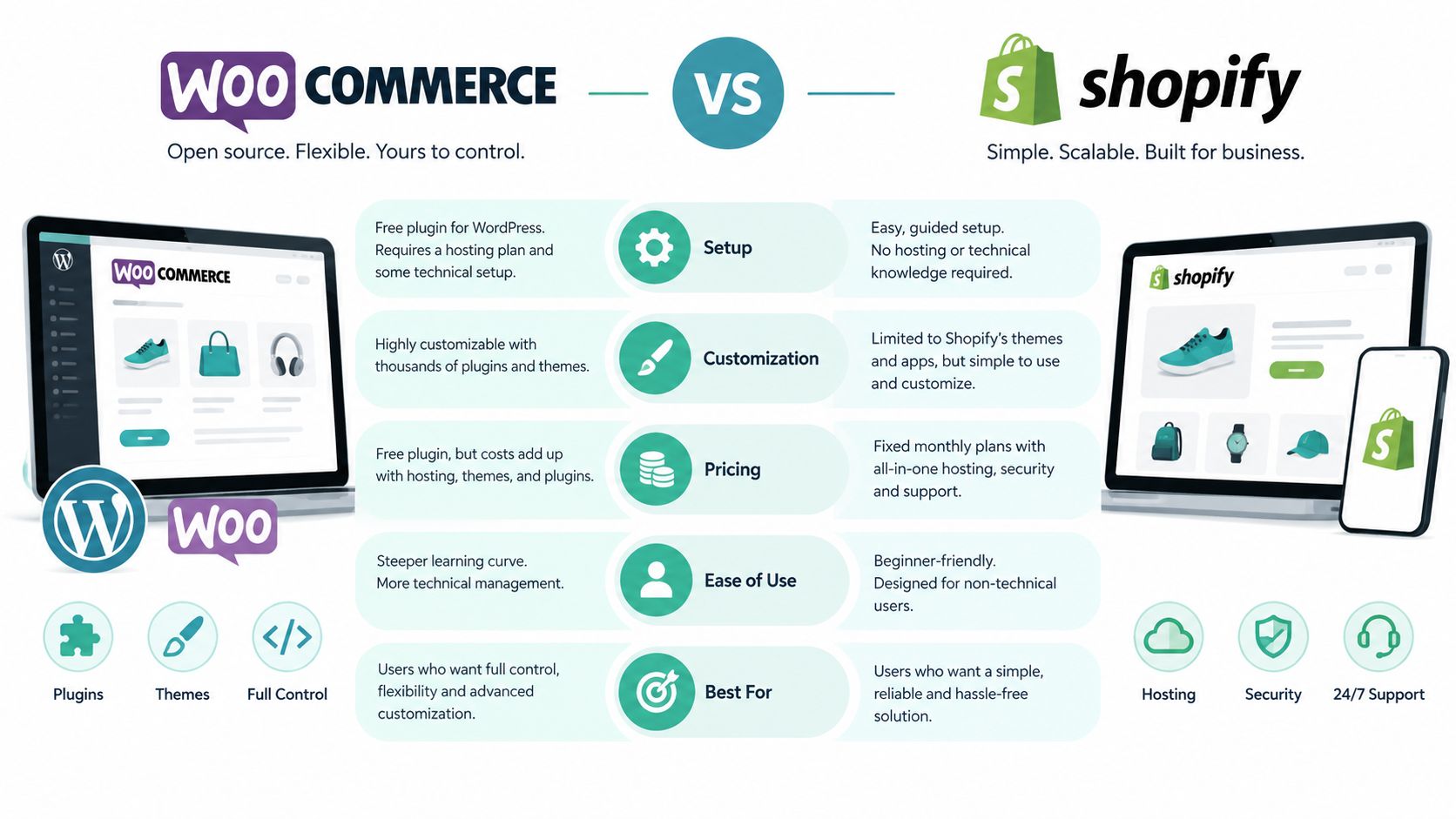
Shopify is a hosted platform. You sign up, choose a theme, configure products, payments, and shipping, and Shopify runs the infrastructure for you. Hosting, core platform security, and much of the operational plumbing sit inside one managed environment.
WooCommerce is a WordPress extension. You run WordPress on your own hosting, add WooCommerce, and build the store on top of that stack. You keep far more control, but you also take responsibility for hosting quality, plugin choices, updates, and maintenance.
What that means in practice
Here's the simple version.
| Platform | Core model | Best fit |
|---|---|---|
| Shopify | Hosted SaaS ecommerce | Businesses that want speed, structure, and less technical responsibility |
| WooCommerce | Self-hosted WordPress ecommerce | Businesses that want ownership, flexibility, and deeper customisation |
If you need a quick primer on the WordPress side, this overview of what WooCommerce is is a useful baseline.
Shopify reduces decisions. WooCommerce increases options. That's the trade-off.
Why the Australian market size matters
This choice isn't happening in a niche market anymore. One independent Australian market analysis puts the number of live Shopify stores in Australia at about 137,573 in 2026, rising from 114,567 in 2024 Q2 to 131,062 in 2026 Q2, with 45,887 based in New South Wales alone. The same analysis notes that another Australian-focused report places the country at roughly 150,000 Shopify websites and ranks Australia third globally for Shopify adoption, which shows how established the platform has become locally (Australian Shopify landscape analysis).
That scale matters because ecosystem size changes implementation risk. When a platform has broad local adoption, it's easier to find agencies, freelancers, app familiarity, and support documentation for Australian merchants.
For WooCommerce, the same principle applies differently. Its strength comes less from a closed local ecosystem and more from the enormous WordPress base, broad developer familiarity, and the ability to shape the stack around your store instead of fitting your store around the platform. If your team needs ongoing help with updates, plugin hygiene, and store upkeep, a resource on managing WooCommerce for small businesses gives a grounded picture of what that responsibility looks like.
Host your website with our 5-star rated, cPanel website hosting plans.
Super fast servers, with security included and hosted in your choice of Australian Data Center.
View cPanel Plans
Total Cost of Ownership in Australia
A Brisbane retailer can spend less to launch on Shopify, then give back that saving every month through subscription GST, app fees, and payment charges. A Melbourne business can choose WooCommerce because it looks cheaper, then burn the difference on weak hosting, plugin sprawl, and avoidable maintenance. That is why monthly price is a poor way to choose.
Australian businesses need to price the whole operating model. Include GST on software charges, payment processing, shipping tools, support, and the cost of keeping the store fast and saleable once the easy setup phase is over.
CommBank's summary of Australia Post's 2025 ecommerce reporting points to stronger value-shopping behaviour and rising retailer investment in AI-led customer experience. That matters because local stores rarely stay simple for long. Cost pressure rises at the same time customer expectations do (Australia Post ecommerce report summary).
WooCommerce vs Shopify Cost Comparison for Australia
| Cost Factor | Shopify | WooCommerce |
|---|---|---|
| Platform structure | Monthly subscription for the platform | No platform fee, but you pay for hosting and the rest of the store stack |
| Transaction costs | Shopify Payments fees apply, and can become one of your biggest ongoing costs at volume | No platform transaction fee. Payment gateway fees still apply |
| GST on subscription and labels | Australian stores are subject to 10% GST on Shopify subscription charges and shipping-label purchases, unless the merchant is registered for Australian GST and adds an ABN to the store (Shopify Australia billing taxes help article) | Depends on your hosting and software vendors. Treatment varies by provider |
| GST on payment processing fees | Shopify states GST at the current rate of 10% is included in all Shopify Payments processing fees in Australia (Shopify Payments Australia tax reporting) | Depends on your payment provider and vendor setup |
| Hosting cost | Included in the platform | Separate line item. Hosting quality directly affects speed, uptime, and admin overhead |
| Apps and extensions | Quick to add, but recurring app subscriptions add up fast | Plugin and extension costs vary widely. A disciplined build stays lean. A messy one gets expensive |
| Maintenance | Lower technical workload day to day | Updates, backups, security, and compatibility checks sit with you or your agency |
Where the real cost gap shows up
Shopify usually wins for cost certainty early. You can launch fast, the billing is tidy, and there are fewer moving parts to manage.
The trade-off shows up later. Australian merchants often underestimate how much Shopify costs once subscription GST, paid apps, and payment fees are all running together. If your margins are tight or your order count is climbing, those ongoing charges matter more than the base plan.
WooCommerce flips the equation. The software itself can be cheaper to own over time, especially if you already run WordPress properly and want more control over checkout, content, or custom workflows. But poor hosting and sloppy upkeep wipe out that advantage quickly.
This is the part many SMBs miss. WooCommerce is not cheaper by default. It is cheaper when the build is disciplined.
A better way to budget
Price both platforms over 12 months, not 30 days.
Your spreadsheet should include platform fees, GST treatment, payment charges, app or plugin renewals, support, development time, and routine maintenance. For WooCommerce, add realistic hosting and care plan costs instead of pretending someone on the team will “just handle it”. If you need a baseline for that line item, this guide to annual web hosting costs in Australia is useful context.
My recommendation is straightforward:
- Choose Shopify if you want tighter operational simplicity and you are comfortable paying more for that convenience over time.
- Choose WooCommerce if you want lower long-term platform costs, better content flexibility, and you have the setup discipline to keep hosting, plugins, and maintenance under control.
- If you are comparing agency quotes, reject any estimate that leaves out payment fees, GST implications, renewals, or support. Those are real costs, not optional extras.
For Australian SMBs, the better platform is usually the one with the lower total cost after a year of trading, not the one with the cheaper first invoice.
Hosting Performance Security and Everyday Control Compared
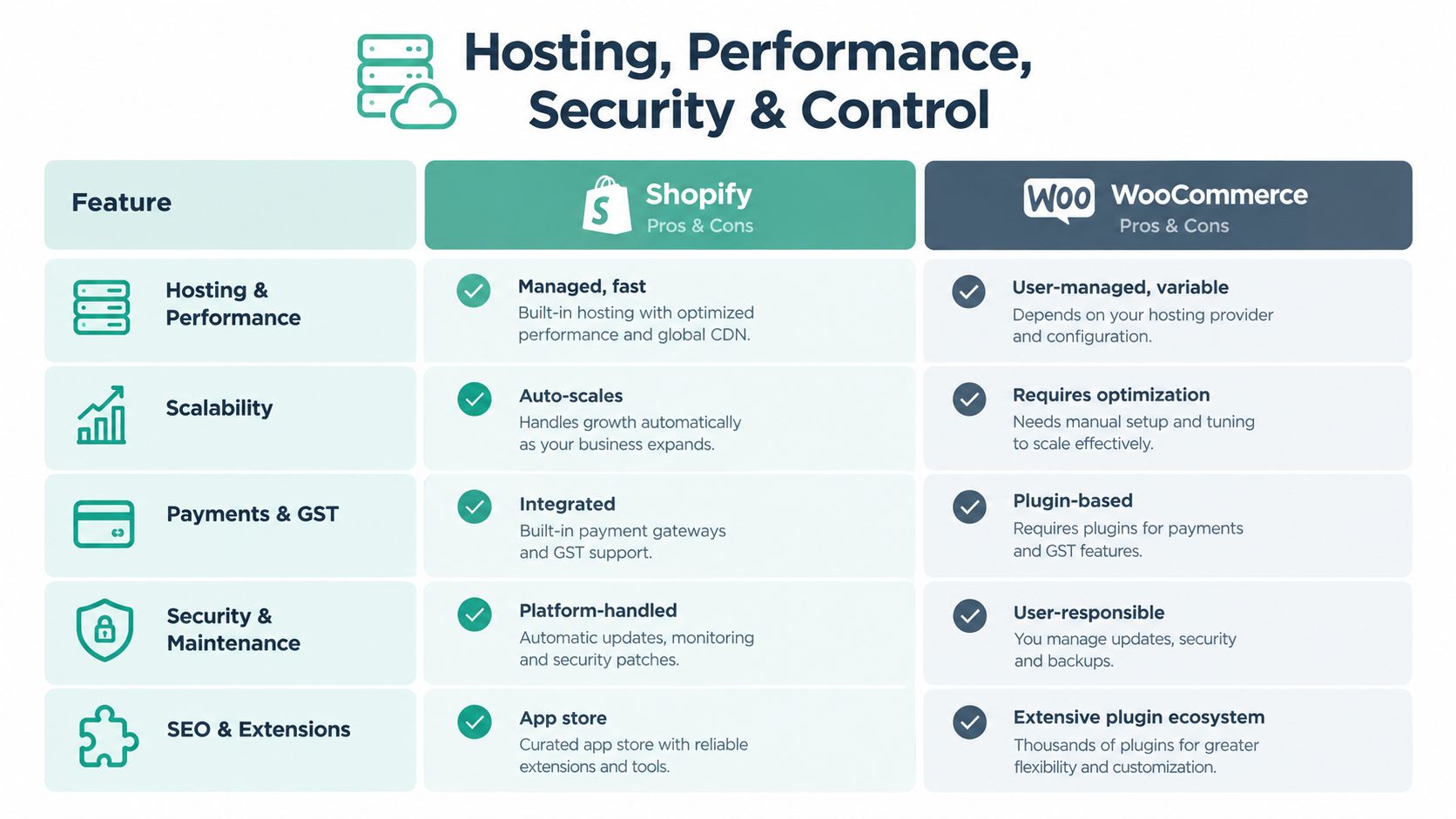
A Melbourne retailer on Shopify can be live fast and sleep well knowing the platform handles the server, patches, and checkout infrastructure. A Brisbane wholesaler on WooCommerce can run a faster, more flexible store with tighter local control. They also inherit the job of keeping it maintained properly. That is the trade-off.
Hosting and performance
Shopify gives Australian SMBs a simpler operating model. Hosting is bundled in, the core stack is managed for you, and capacity spikes are Shopify's problem. If your priority is predictable operations with a small team, that matters more than raw technical flexibility.
WooCommerce gives you the opposite deal. You choose the host, caching, CDN setup, PHP workers, image handling, and database performance. That control is valuable if you know why you need it. It is expensive if nobody is responsible for setup quality.
Here is the blunt view. A well-built WooCommerce store on good local infrastructure can feel quicker than a heavily customised Shopify store. A cheap WooCommerce build on weak hosting will feel worse than Shopify almost every time.
For Australian businesses, server location and governance can matter as much as speed. If your business has procurement rules, client contracts, or internal risk policies around where systems are run, review your options for Australian data sovereignty hosting before you lock in the platform.
Security and maintenance
Shopify reduces your maintenance load. The platform handles the core environment, security updates, and much of the infrastructure risk. That is a strong fit for retailers who want fewer moving parts and less technical decision-making.
WooCommerce can be perfectly secure, but only with active ownership. Plugins need updating. Backups need testing. Themes need compatibility checks. Malware scanning, firewall rules, and performance tuning need a process, not good intentions.
That is where Australian total cost of ownership shows up in real life. Shopify charges more for convenience, but the maintenance burden is lighter. WooCommerce can cost less over time, yet only if your hosting and support setup is competent from day one.
A simple rule works well here:
- Choose Shopify if no one on your team wants to manage hosting, updates, or plugin risk.
- Choose WooCommerce if you want infrastructure control and you already have a reliable developer or care plan.
SEO and content flexibility
Content-heavy brands usually work better on WooCommerce because WordPress is still the stronger publishing system. If your growth plan depends on suburb pages, guides, case studies, service content, or large catalogues with supporting articles, keeping content and commerce in one stack is usually easier to run.
Shopify can still rank well. But content teams often hit platform limits sooner, especially when page structures, editorial workflows, or custom content relationships get more involved.
Extensions and custom workflows
Shopify apps are convenient, and that convenience has a cost. Many stores end up stacking monthly app fees to cover functions that WooCommerce can handle with a one-off plugin or custom build. For Australian SMBs comparing total ownership cost, this matters more than feature lists.
WooCommerce is usually the better fit once the business has unusual rules. Wholesale pricing, account-based ordering, mixed quote and checkout flows, custom freight logic, or WordPress-led lead generation are all easier to shape on WooCommerce without fighting the platform.
Support and day-to-day control
If your team wants one vendor accountable for the platform, Shopify is easier to live with. The Australian help and contact hub gives merchants a clear support path and localised documentation (Shopify Australia contact and help hub).
If your team wants direct control over plugins, theme logic, the database, and hosting performance, WooCommerce gives you more room to work. That freedom is useful only when somebody competent is making the calls.
My recommendation is simple. Pick Shopify for operational simplicity. Pick WooCommerce for control, content depth, and custom workflows. In Australia, the wrong choice usually shows up in hidden maintenance costs, not in the monthly sticker price.
Which Platform Fits Your Business Model Best
The best answer to WooCommerce or Shopify usually appears when you stop comparing features and start looking at the business model.
Australia-focused snapshots underline why this comparison matters locally. One 2026 snapshot estimated 153,140 Shopify stores versus 82,481 WooCommerce stores in Australia, while another put Shopify at 117,625 stores (35.41%) and WooCommerce at 106,237 (31.98%), suggesting Shopify has a materially larger installed base in the local market (Shopify vs WooCommerce Australia comparison). That bigger footprint often means easier access to familiar agencies, apps, and merchant support patterns.
A simple decision matrix
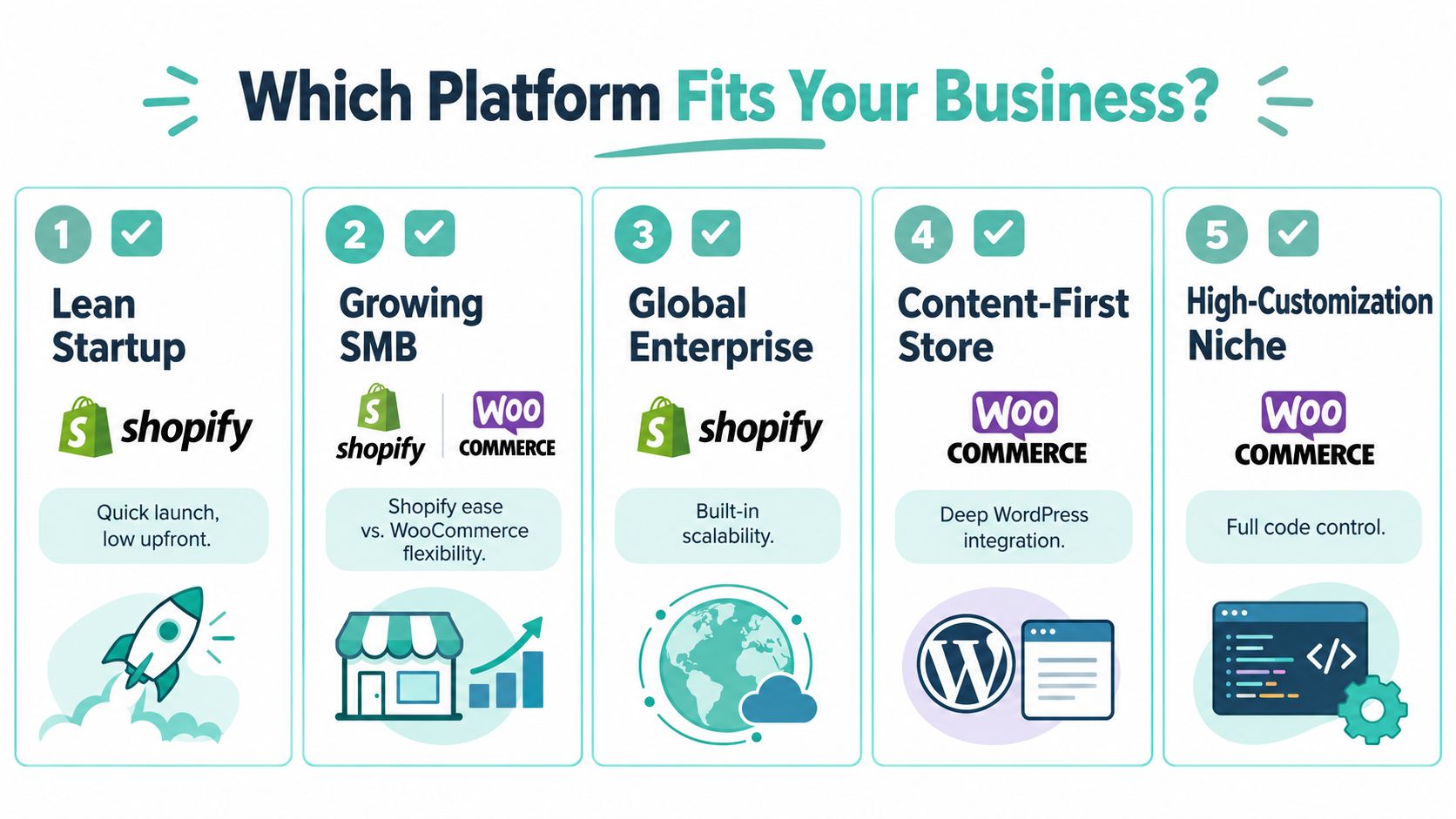
| Business profile | Better fit | Why |
|---|---|---|
| Lean startup needing a fast launch | Shopify | Faster setup, fewer moving parts, lower technical burden |
| Growing SMB with custom processes | WooCommerce | Better flexibility for non-standard workflows |
| Content-first brand already on WordPress | WooCommerce | Cleaner integration between content and commerce |
| Product-led retailer with a small team | Shopify | Easier to operate without a dedicated technical owner |
| Niche business needing heavy customisation | WooCommerce | Full control over code, hosting, and store logic |
What I'd recommend in common Australian scenarios
A founder selling a focused catalogue and wanting to launch quickly should usually pick Shopify. You can get to market faster and avoid drowning in technical setup.
A business with lots of informational content, organic search reliance, and existing WordPress workflows should usually stay in the WordPress ecosystem and use WooCommerce. Splitting content and commerce often creates more complexity than it solves.
A wholesaler, trade supplier, or service-plus-product business usually leans WooCommerce. Those businesses nearly always outgrow a standardised setup because pricing rules, user roles, forms, quoting, and account logic get specific.
A straightforward retail brand with a small internal team usually leans Shopify. Less responsibility is a real advantage when nobody wants to own updates and infrastructure.
For founders still comparing broader online selling options before narrowing to these two, this platform for selling online guide is a useful secondary read.
For a more platform-comparison angle from an Australian hosting perspective, this guide to Wix vs Shopify vs WooCommerce helps frame where WooCommerce and Shopify sit in the wider decision.
Pick Shopify if you want the platform to remove decisions. Pick WooCommerce if those decisions are where your competitive advantage lives.
Register your new domain name at competitive market prices including free domain add-ons like privacy, DNS Hosting, Custom Nameservers and Forwarding.
Always the best price and no nasty renewal price hikes.
Register A Domain Name
Deploying Your Store the Australian Way
Once you've chosen, the next mistake is rushing setup and recreating problems inside a better platform.

If you choose Shopify
Keep the setup disciplined.
- Sort tax settings early. Check your GST setup, and if you're registered, make sure your store details reflect that correctly so billing treatment is handled properly.
- Decide on payments before theme extras. Payment structure affects operating cost more than cosmetic tweaks do.
- Keep apps lean at launch. Install what you need for selling, fulfilment, and retention. Don't turn the store into a stack of overlapping subscriptions in week one.
- Write local policy content properly. Delivery, returns, and service expectations matter in Australia and shape trust fast.
If you choose WooCommerce
The setup priorities are different because the store quality depends on the stack underneath it.
Look for Australian hosting with local infrastructure, current PHP support, strong backups, SSL, malware scanning, and a performance layer that suits WordPress and WooCommerce. LiteSpeed and practical WordPress optimisation matter. So does having support that understands ecommerce issues rather than generic hosting tickets.
One option in that category is UpTime Web Hosting, which offers Australian WordPress and WooCommerce-ready hosting with local servers, free SSL, malware scanning, DDoS-protected firewalls, nightly off-site backups, LiteSpeed, and AccelerateWP. That sort of stack is the difference between WooCommerce feeling reliable and WooCommerce feeling fragile.
A clean launch checklist
- For Shopify stores: keep the app stack tight, test checkout thoroughly, and confirm GST handling before going live.
- For WooCommerce stores: choose hosting first, not last. Then lock in backups, SSL, update workflow, and plugin discipline.
- For both: write shipping rules clearly, test mobile checkout, and make sure someone owns post-launch maintenance.
If you're launching locally and need a practical baseline for the whole process, this guide to selling online in Australia is worth keeping open while you work through setup.
Final Recommendation and Next Steps for Your Decision
Here's the blunt version.
Choose Shopify if you want to launch quickly, keep technical responsibility low, and run a fairly standard ecommerce model with a small team. It's the cleaner choice for businesses that value convenience and structure over deep control.
Choose WooCommerce if your store is tied to WordPress, your content matters, your workflows are specific, or you want more control over hosting, performance, and custom functionality. It usually makes more sense for businesses that expect the store to evolve beyond a standard template.
Use this quick checklist:
- Pick Shopify if speed, simplicity, and lower admin burden matter most.
- Pick WooCommerce if ownership, flexibility, and deeper tailoring matter most.
- Lean toward Shopify if nobody in the business wants to manage a web stack.
- Lean toward WooCommerce if your business already depends on WordPress or custom logic.
- Recheck the numbers if payment fees are likely to become a meaningful margin issue.
One more local datapoint supports why many Australian businesses start with Shopify. An Australia-focused comparison article reports 153,140 live Shopify stores versus 82,481 WooCommerce stores in Australia, showing Shopify with roughly a 1.9-to-1 lead in active Australian stores (Australian store comparison snapshot). That doesn't make Shopify automatically better. It does mean the local support and familiarity advantage is real.
The right answer isn't the platform with the lowest entry price. It's the platform with the lowest friction for the way your business will actually operate in Australia.
If WooCommerce is the better fit, local hosting quality will shape the result more than most merchants expect. UpTime Web Hosting offers Australian hosting options that suit WordPress and WooCommerce stores, including local infrastructure, security features, backups, and support for businesses that need a dependable ecommerce base. If you're still weighing WooCommerce or Shopify, it's a sensible place to compare the hosting side of the decision before you commit.