In short
Australian VoIP companies should be compared on support, number porting, call routing, device compatibility, security, outage continuity and total cost, not on a ‘best provider’ label. Shortlist providers that will document the migration, demonstrate your real call flows, explain 000 limitations and give a complete written price for the same business requirements.
Key takeaways
- Only active phone numbers can be ported, and individual Australian local-number ports generally take 8 to 15 days, while complex ports can take up to 30 days, according to ACMA's number-porting guidance.
- Most services connected through the NBN will not work during a power outage, so continuity requires more than a provider's platform uptime promise, as explained in ACMA's emergency-call guidance.
- The cheapest headline price is not the cheapest system unless the comparison includes licences, numbers, calls, setup, porting, hardware, support, optional services, exit costs and GST.
- A provider should demonstrate the business's real call flows, supported devices, mobile applications, 000 arrangements and outage fallbacks before a full migration begins.
- The VoIP administration portal should support multi-factor authentication, individual accounts and restricted privileges, consistent with the Australian Signals Directorate's 2026 small business guidance.
Contents
- What should you decide before comparing VoIP companies?
- Which support promises should you get in writing?
- Can you keep your existing business phone numbers?
- Will the system keep working when power or internet fails?
- Which call features and devices need a real-world test?
- How secure should a business VoIP service be?
- How do you compare the total monthly cost?
- What should you test before signing a contract?
- What else do Australian businesses ask about VoIP providers?
- What should you do before asking for quotes?
A reliable business VoIP provider is not necessarily the one with the longest feature list. It is the provider that can show, in writing and in a pilot, how the service will handle your numbers, callers, staff, devices and failures. This checklist is for Australian small and medium businesses replacing or upgrading a phone system, rather than residential buyers or wholesale resellers.
What should you decide before comparing VoIP companies?
Start with a one-page requirements brief covering the people, numbers, locations, devices and call flows the system must support. Without one common brief, each provider will quote a different solution and the prices will not be comparable.
The eight-point shortlist
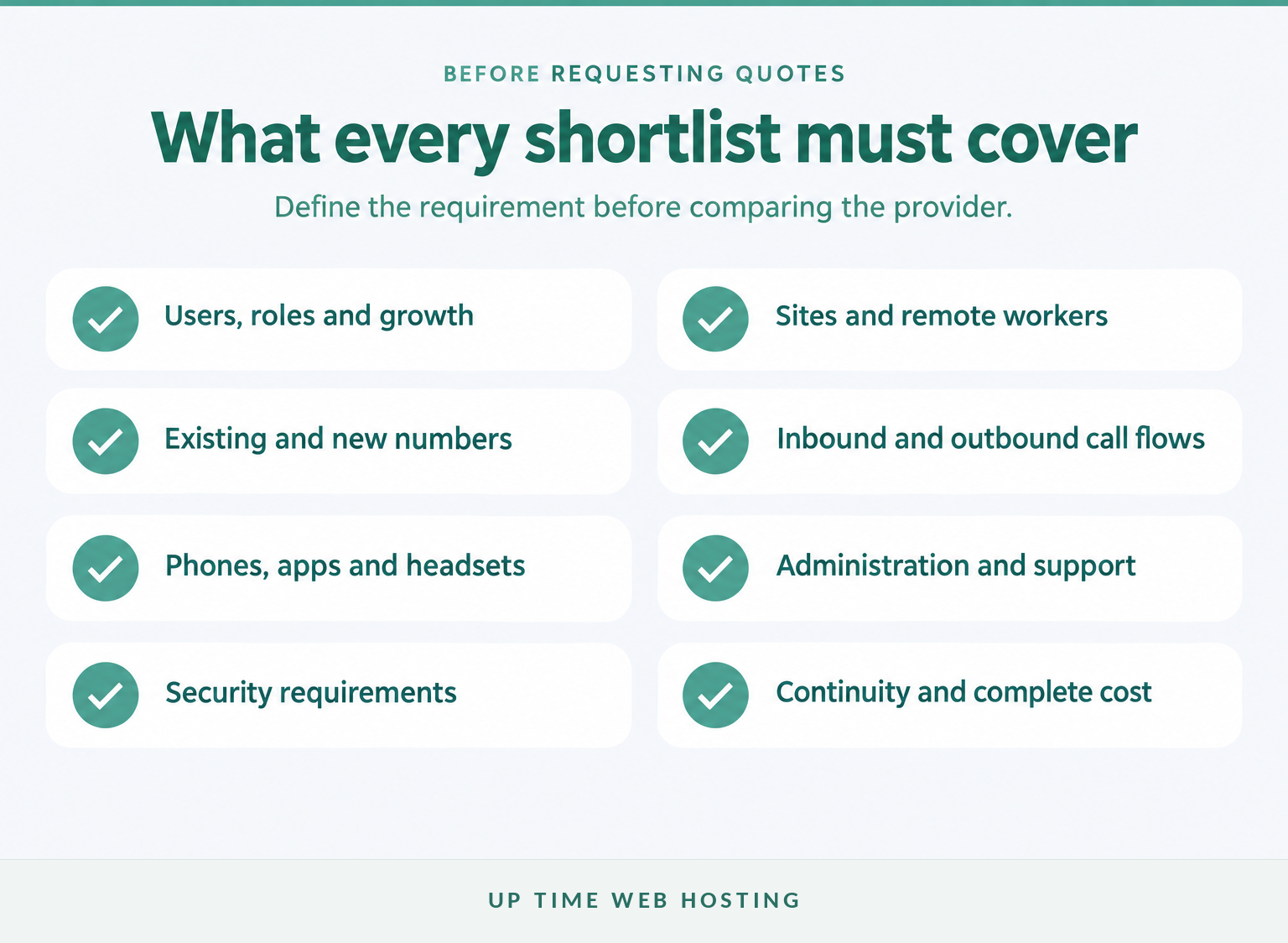
Write down the same information for every provider:
- People: staff numbers now, expected growth and any shared reception or contact-centre roles.
- Locations: offices, home workers, mobile staff and sites with limited connectivity.
- Numbers: every local, mobile, 13, 1300 and 1800 number that must be retained or added.
- Inbound calls: greetings, menus, queues, ring groups, overflow, voicemail and after-hours rules.
- Outbound calls: expected destinations, caller ID requirements and any international calling.
- Devices: desk phones, cordless handsets, conference phones, headsets, computers and mobile applications.
- Administration: who will add users, change routing, review reports and manage recordings or voicemail.
- Failures: what callers and staff should experience during power, internet, provider or building outages.
If the business has not yet decided which system model it needs, first clarify the difference between VoIP and a traditional phone system. That decision affects hardware, internet dependence, migration work and ongoing administration.
Send the finished brief to every shortlisted provider unchanged. Ask each provider to identify any requirement it cannot meet, any feature requiring an extra licence and any assumption that could change the quote.
A fair comparison starts with one written requirements brief that every provider must answer.

Performance you can feel, backed by clients who depend on it. Read how our support and uptime create long‑term customer success.Power Your Business with Better Hosting
Which support promises should you get in writing?
A provider's sales response does not show how faults will be handled after the service is live. Ask for support hours, escalation paths, response targets and responsibilities in writing before treating local or Australian support as a differentiator.
Australian support can refer to a time zone, a local office, an Australian employee or simply an Australian telephone number. Confirm what the claim means by asking:
- Which support channels are available during business hours and after hours?
- Are urgent voice outages handled differently from routine configuration requests?
- What is the target first-response time, and is there a separate resolution target?
- Who can escalate a fault to the underlying carrier or platform operator?
- Is onboarding, call-flow configuration and staff training included?
- How are planned maintenance and unplanned incidents communicated?
- Is there a public service-status page and a documented complaints process?
ACMA's current guidance on choosing a provider says telcos should provide clear information about products, pricing, contracts, billing and complaint handling. Use those documents alongside the sales proposal.
If a quote includes hosted call control, understand what a cloud PBX controls before comparing platform labels. The provider should explain who configures extensions, queues, schedules, voicemail, applications and failover routes.
Support quality is measurable only when hours, escalation paths and response commitments are written down.
Can you keep your existing business phone numbers?
Most Australian businesses can usually port active local, mobile, 13, 1300 and 1800 numbers to another provider. The new provider should confirm that it accepts each number type and provide a written cutover plan before any existing service is cancelled.
As of November 2026, ACMA's number-porting guidance says individual local-number ports generally take 8 to 15 days, while more complex ports involving multiple local numbers can take up to 30 days, with limited exceptions. Only active numbers can be ported.
A safer porting sequence
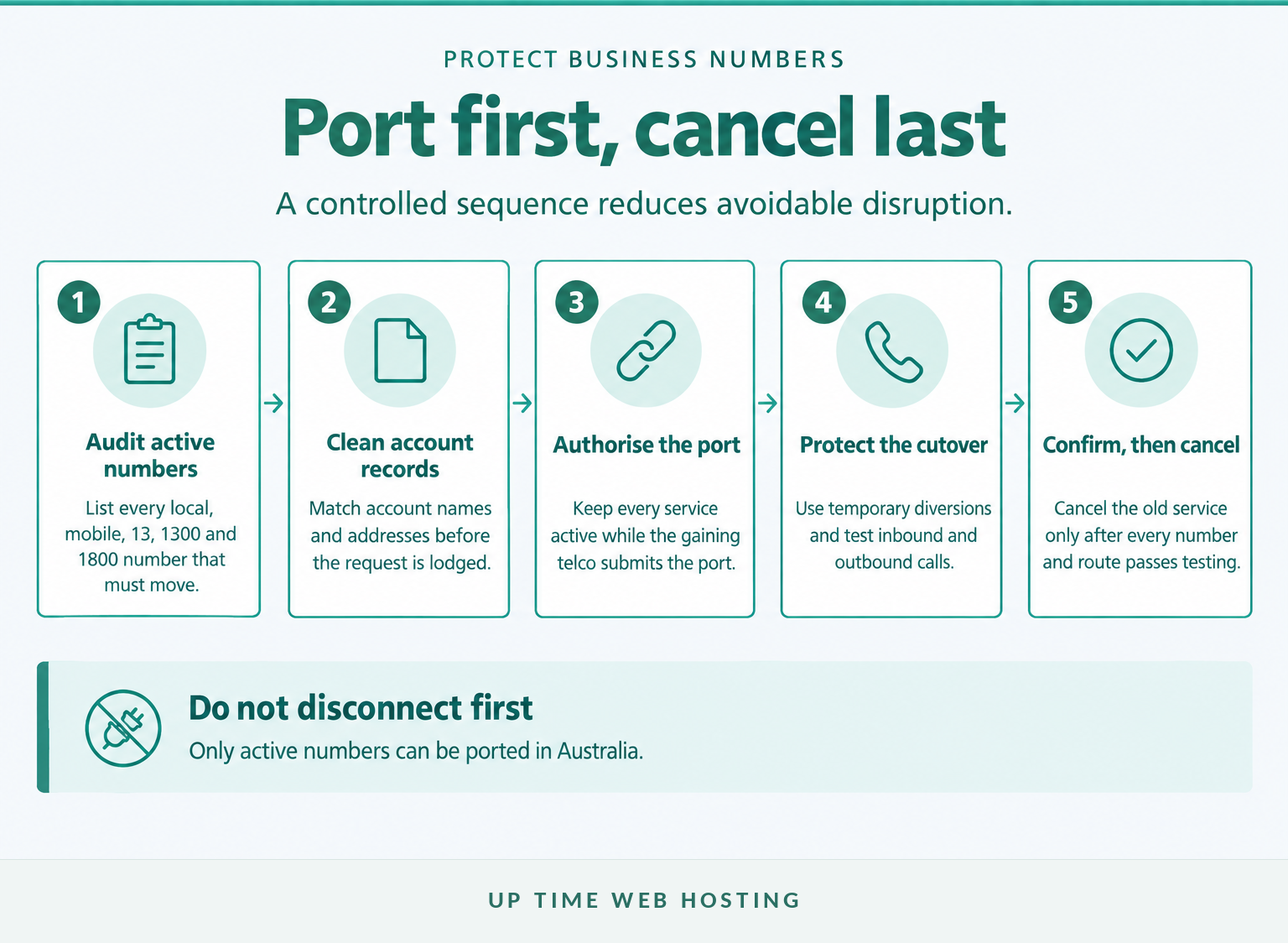
Create a complete number inventory before signing. Include the account holder, service address, current provider, account number, number type and the call route that should apply after the move.
Ask the new provider to check the records before lodging the port. Mismatched account details can delay a request, while disconnecting the old service too early can remove the right to use the number.
The cutover plan should identify:
- who authorises the port;
- which numbers move together;
- what temporary routing will protect incoming calls;
- how inbound and outbound calls will be tested; and
- when the old service may safely be cancelled.
Keep a rollback contact list for the old and new providers. Do not assume that a successful test call to one number proves that every direct number, queue, caller ID and after-hours route is working.
Keep every number active until the new provider has completed and tested the port.
Host your website with our 5-star rated, cPanel website hosting plans.
Super fast servers, with security included and hosted in your choice of Australian Data Center.
View cPanel Plans
Will the system keep working when power or internet fails?
A platform uptime figure does not cover the router, NBN equipment, switches, Wi-Fi, desk phones or power inside the business. Compare providers by the failure plans they can configure and test, not just by the availability percentage in a brochure.
ACMA states that only certain VoIP services can call Triple Zero and that most NBN-connected services will not work during a power outage. nbn's power-blackout guidance also says each mains-powered item connected to the network requires its own battery backup if it is expected to keep working.
Build three separate fallbacks
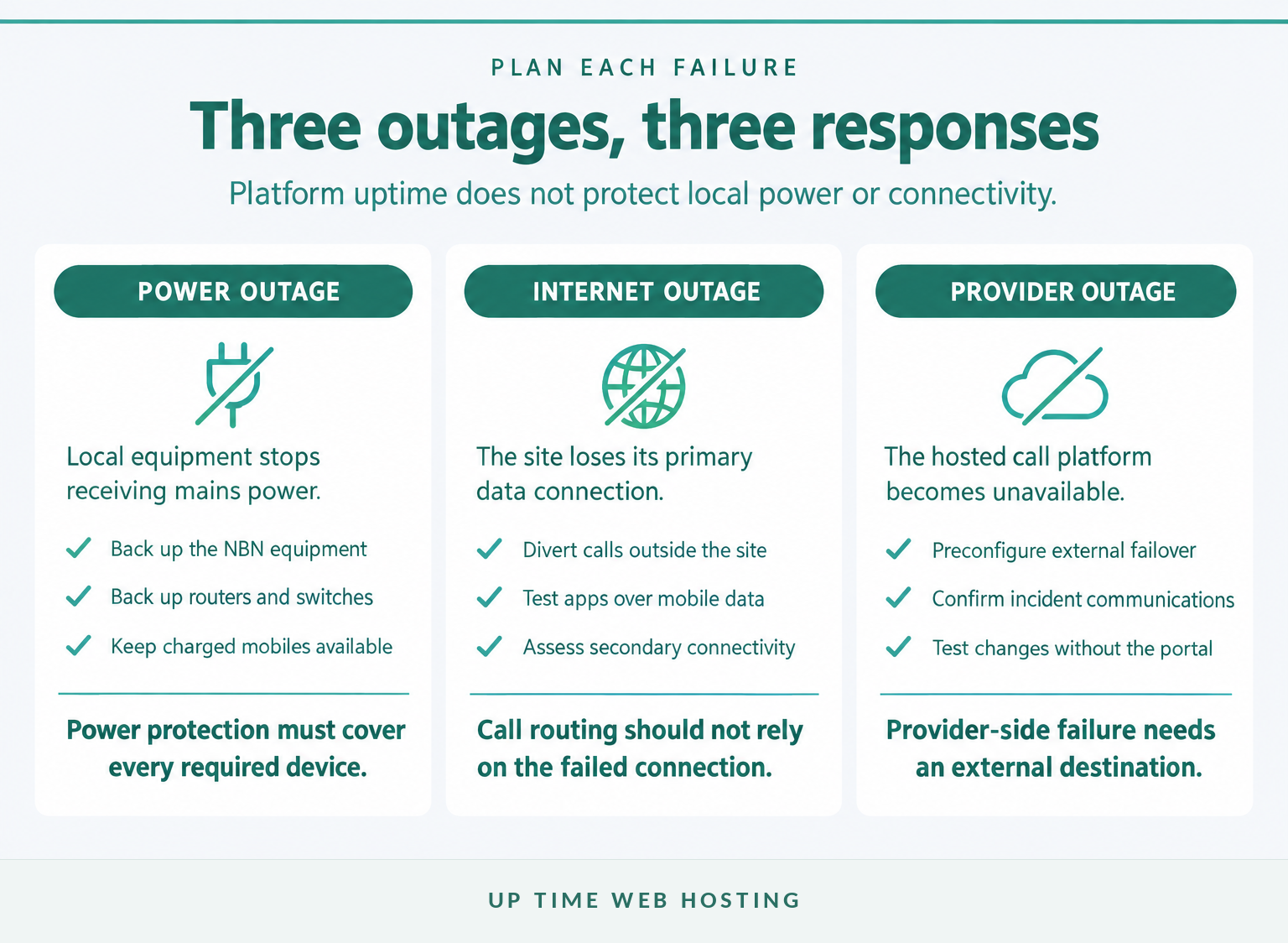
Power outage: Identify every powered component between the handset and the internet service. A UPS may support the local NBN equipment, router, switches and phones for a limited period, but the plan should still include charged mobiles and clear emergency instructions.
Internet outage: Ask whether incoming calls can divert outside the affected site without relying on the failed router. Test mobile applications over mobile data and decide whether a secondary internet service is justified for critical locations.
Provider or platform outage: Confirm whether numbers can fail over to external mobiles or another destination, how quickly the route activates and who can change it when the administration portal is unavailable.
Also plan for a building that cannot be entered because of a fire, flood or local incident. Businesses with mobile and remote staff can use the same principles described for virtual office phone systems, but each route still needs a real test.
Document how staff will reach 000, what location information they must provide and which charged mobile devices remain available during a blackout.
VoIP continuity requires separate fallbacks for power, internet, provider and site failures.
Which call features and devices need a real-world test?
A feature counts only when it works in the business's actual call flow on supported devices. Ask the provider to demonstrate the proposed configuration instead of accepting a tick beside terms such as queue, mobile app, recording or integration.
The demonstration should cover common and difficult situations:
- a new customer calling during business hours;
- an unanswered call overflowing to another person or group;
- a warm and blind transfer between desk phones and applications;
- an after-hours caller leaving a message or reaching an on-call person;
- a remote worker moving between Wi-Fi and mobile data;
- outbound caller ID and a customer returning that call;
- voicemail notifications reaching only authorised recipients; and
- a call made while the primary office internet connection is unavailable.
For hardware, ask for the exact supported model, firmware, provisioning method and power requirement. Confirm headset support, Power over Ethernet requirements and whether analogue equipment needs an adaptor. Provider-supported is more useful than merely standards-compatible because it determines who will troubleshoot the device.
Businesses handling sensitive conversations can adapt the phone-system controls used by a small law office to review recording, voicemail, permissions and routing. A broader overview of VoIP phone systems for small business can help map desk phones, applications and hosted calling to different staff roles.
A feature counts only after it works in the business's real call flow on supported devices.
How secure should a business VoIP service be?
Treat the VoIP administration portal, user accounts and call data as critical business systems. The provider should explain the controls it supplies, while the business should restrict access and remove accounts promptly when staff change roles or leave.
The Australian Signals Directorate's October 2026 guidance on securing accounts and identities recommends multi-factor authentication, strong unique passwords, individual accounts and least-privilege access. Apply those principles to provider portals and applications.
Ask each provider:
- Is multi-factor authentication available for administrators and users?
- Can every administrator have an individual account rather than a shared login?
- Can permissions be limited by role?
- Are configuration changes and sign-ins logged?
- How are handset firmware and applications updated?
- How does support obtain temporary access to the account?
- What encryption is available for signalling, calls and stored recordings?
- Where are recordings, voicemail and reports stored, and how long are they retained?
- Can international or premium calling be restricted when it is not required?
- What happens if unusual calling activity or suspected account compromise is detected?
Security claims should be demonstrated in the portal and recorded in the proposal. A statement that the platform is secure is not a substitute for confirming which controls are enabled on the quoted plan.
The provider's administration portal should be protected like any other critical business system.
Register your new domain name at competitive market prices including free domain add-ons like privacy, DNS Hosting, Custom Nameservers and Forwarding.
Always the best price and no nasty renewal price hikes.
Register A Domain Name
How do you compare the total monthly cost?
Compare every quote using the same user count, number inventory, calling pattern, hardware list and contract period. Separate recurring charges from one-off costs so an inexpensive monthly fee does not hide a costly migration or equipment requirement.
ACMA says telcos must make a Critical Information Summary available for each product, service and plan. Read it with the formal quote and contract, then ask the provider to explain any difference between them.
Compare the whole cost
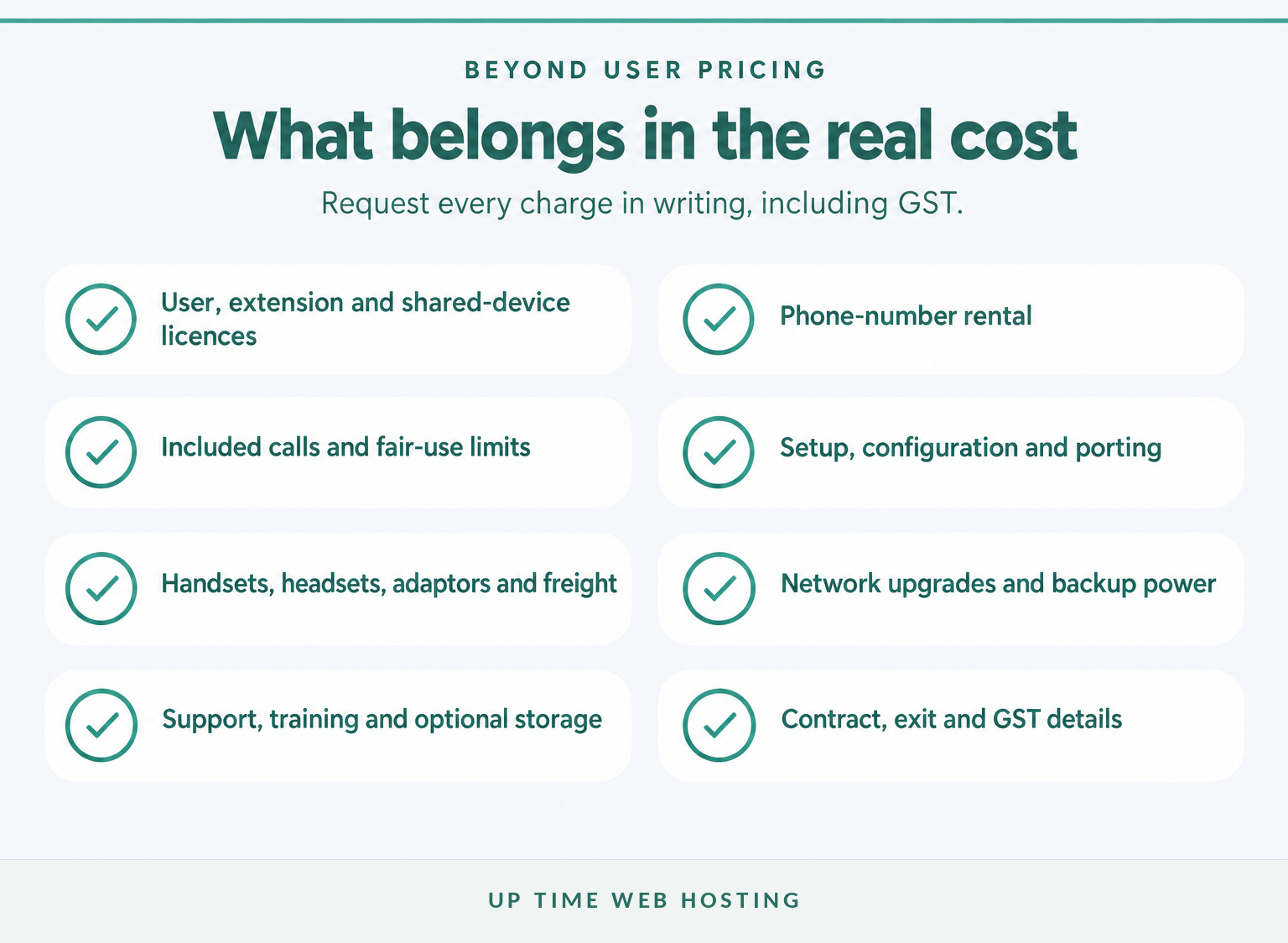
| Cost item | What the written quote should show |
|---|---|
| Service licences | Per-user, per-extension, shared-device and administration licences |
| Phone numbers | Local, mobile, 13, 1300 and 1800 number rental |
| Calls | Included destinations, exclusions, fair-use rules and excess rates |
| Setup and porting | Configuration, number ports, project work and after-hours cutover fees |
| Hardware | Handsets, headsets, adaptors, power supplies, freight and warranties |
| Network work | Switches, cabling, router changes, secondary internet and UPS equipment |
| Optional services | Recording, storage, reporting, integrations, transcription and messaging |
| Support and training | Included support, chargeable work, onboarding and staff training |
| Contract changes | Minimum term, cancellation, equipment return and exit costs |
| Tax and billing | GST, billing frequency, payment fees and price-review terms |
Calculate the complete cost over the same period for every quote. If call volumes vary, ask for a sample bill based on recent usage or provide an anonymised current bill so the provider can model the same destinations.
Do not award a provider extra points for features the business will not use. A smaller plan with suitable support and continuity may offer better value than a feature-heavy service that requires extra administration.
The cheapest VoIP quote is the one with the lowest complete cost, not the smallest headline fee.
What should you test before signing a contract?
Do not sign solely from a proposal or scripted demonstration. Run a small pilot with agreed pass-or-fail criteria that reflect the locations, devices, routes and failure conditions in the requirements brief.
The pilot should test:
- inbound and outbound call quality during a normal busy period;
- every greeting, queue, ring group, overflow and after-hours rule;
- transfers between desk phones, computers and mobile applications;
- supported headsets, cordless devices and conference equipment;
- caller ID, voicemail and notifications;
- internet-failure and power-failure procedures;
- administrator access, multi-factor authentication and audit logs; and
- the provider's support process using a genuine configuration request or fault.
Record who owns each test, the expected result and what happened. Agree on the cutover window, customer communications, staff training, rollback trigger and post-migration support period before the main port begins.
Request a final design showing numbers, users, devices, call routes and fallbacks. This document becomes the baseline for acceptance testing and future changes.
A pilot should turn promises into pass-or-fail tests before the contract becomes difficult to unwind.
Experience Microsoft 365 Business Standard for free for 30 days.
Up to 25 users with full access to email, OneDrive and Teams. Includes full versions of desktop apps of Outlook, Word, Excel, PowerPoint and more.
Try Microsoft 365
What else do Australian businesses ask about VoIP providers?
Price and hardware questions often appear simple, but the useful answer depends on the complete system rather than one plan feature. These answers provide a starting point for discussions with shortlisted business VoIP providers in Australia.
Which VoIP provider is the cheapest?
No VoIP provider is cheapest for every Australian business. A low user fee may exclude numbers, calls, porting, handsets, support, recording or GST. Compare providers against the same user count and call pattern, then total recurring and one-off charges over the same period before deciding.
Can I just plug a VoIP phone into my router?
Sometimes, but not automatically. The handset must be supported by the provider, configured with the correct account details and connected to suitable power and networking. A Power over Ethernet phone also needs a compatible PoE switch or injector. Confirm the exact model and test calling before buying a fleet.
Are there any Australian phone brands?
Yes, Australian-owned phone and communications businesses exist, but provider ownership, support location and handset manufacturing are separate questions. An Australian provider may supply overseas-made handsets. Ask who owns the service, where support is delivered, which hardware is supported and where customer data is handled before treating an Australian label as a complete answer.
What are the most affordable VoIP providers in Australia?
The most affordable provider is the one with the lowest complete cost for the features and support the business will actually use. Request written quotes in AUD, including GST, for identical users, numbers, calls, hardware, setup, porting and support. Exclude any quote that cannot meet the required continuity or security controls.
Affordable VoIP means meeting the required service level at the lowest complete cost.
What should you do before asking for quotes?
Turn this checklist into a short requirements brief and give the same version to every provider. Require written answers, a whole-cost quote and a pilot plan so the final decision can be based on evidence rather than a generic feature list.
Before contacting providers:
- inventory every number, user, device and location;
- draw the current and desired call flows;
- define support, security and continuity requirements; and
- choose the tests that must pass before migration.
When the requirements are ready, ask Up Time Web Hosting for a written VoIP Telephony proposal and pilot plan based on the business's actual users, numbers, call routes and fallback needs.
The right provider is the one that can prove how calls, numbers and fallbacks will work before migration begins.