In short
An Australian VoIP number should match how customers contact the business: choose a geographic 02, 03, 07 or 08 number for local identity, a virtual 04 number when a mobile-style identity is useful, 1300 for one national entry point, or 1800 when minimising caller charges is the priority.
Key takeaways
- Geographic Australian business numbers have 10 digits and begin with 02, 03, 07 or 08, while mobile numbers have 10 digits and begin with 04, according to ACMA's current number-type guidance.
- An active local, mobile, 13, 1300 or 1800 number can usually be moved to another provider, but a disconnected number normally cannot be ported under ACMA's porting guidance.
- The ACMA says 13, 1300 and 1800 numbers cannot be used for caller ID overstamping, so a separate permitted callback number may be required for outbound calls under ACMA's caller ID guidance.
- One advertised number can route to several staff, but the number itself does not determine how many simultaneous calls the service can carry.
- An 04 prefix does not guarantee two-way SMS, WhatsApp registration or acceptance by services that send verification codes.
Contents
- How do Australian VoIP numbers work?
- Which Australian VoIP number type should you choose?
- When is a local geographic number the best fit?
- Should your business use a virtual mobile number?
- Is a 1300 or 1800 number better?
- Can you keep your existing number when moving to VoIP?
- What should you check before ordering an Australian VoIP number?
- Can an Australian VoIP number receive SMS or work with WhatsApp?
- What else do Australian businesses ask about VoIP numbers?
- What should you do next?
Choosing the prefix is only half the job. The public number, users, extensions, devices, call routes and available call paths are separate parts of a business phone system, as the guide to how cloud PBX and VoIP are different parts of the system explains.
As of November 2026, Australia's formal numbering framework is the Telecommunications Numbering Plan 2025. Providers apply that framework through their own plans, portals and technical configurations, which is why two services using the same type of number may behave differently.
How do Australian VoIP numbers work?
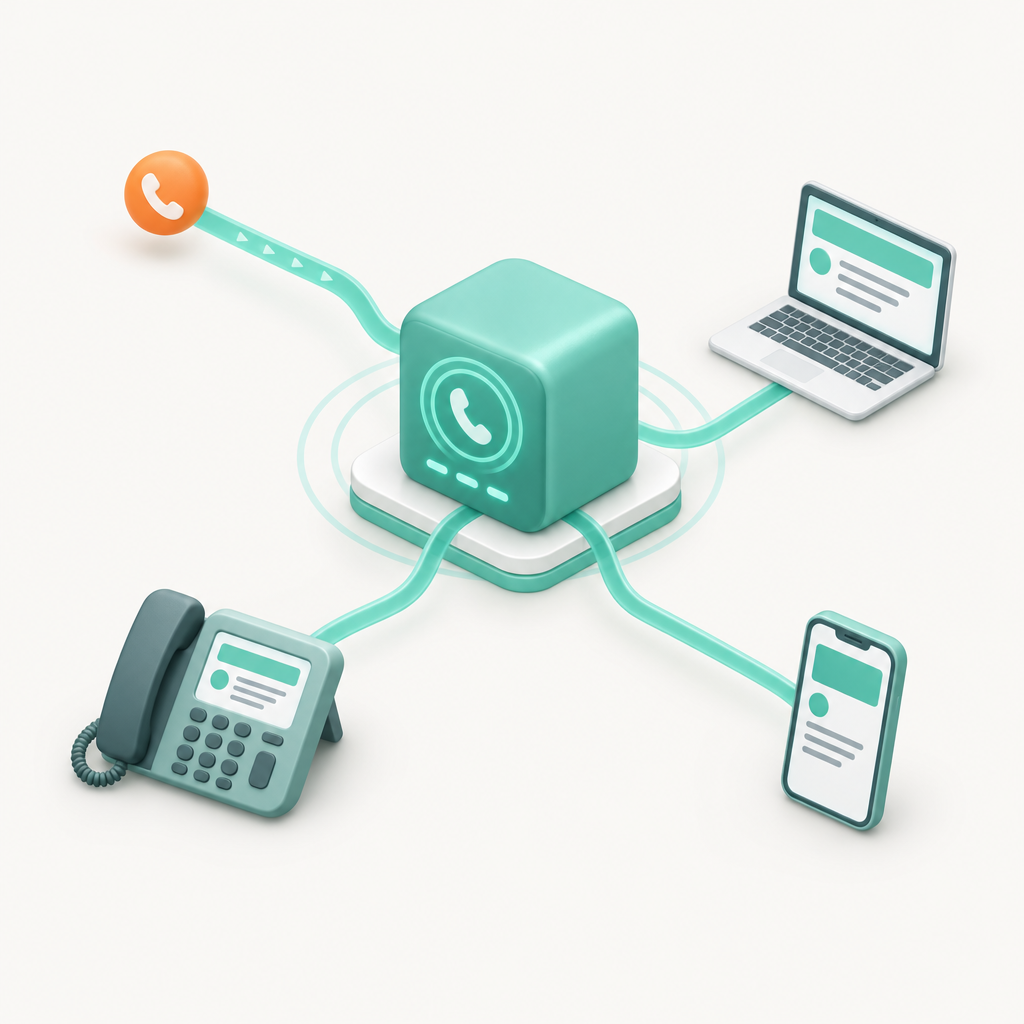
An Australian VoIP number is a public telephone number delivered through an IP-based service rather than a dedicated copper line. The number tells callers what to dial, while the hosted PBX or SIP service decides which users, applications or handsets receive the call.
A caller might dial one number and reach a reception ring group, an automated menu, a call queue or an after-hours route. Staff can answer through compatible desk phones, browser applications, computer softphones or mobile applications, depending on the service.
This separation is useful when a business has remote staff or more than one workplace. The number does not need to change whenever a user changes devices or works somewhere else. An administrator changes the call route instead.
Do not confuse simultaneous ringing with concurrent-call capacity. Simultaneous ringing can alert several devices about one call. Concurrent-call capacity decides whether a second or third caller can enter the system while other calls are already active, so the provider should state the included inbound and outbound call paths.
A VoIP number is the destination; the PBX, call paths and devices determine how many people can answer it.

Performance you can feel, backed by clients who depend on it. Read how our support and uptime create long‑term customer success.Power Your Business with Better Hosting
Which Australian VoIP number type should you choose?
Choose the number type by the identity customers should recognise and the way calls must be handled. A local number suits regional trust, an 04 virtual mobile suits a mobile-style identity, and 1300 or 1800 suits a national inbound entry point.
| Number type | Australian format | Strongest fit | Check before ordering |
|---|---|---|---|
| Geographic local | 02, 03, 07 or 08 | Businesses that want a familiar regional number | Area expectations, outbound caller ID and porting eligibility |
| Virtual mobile | 04xx xxx xxx | Mobile-style identity, field teams or confirmed SMS workflows | Voice, two-way SMS, application support and verification acceptance |
| Local rate | 1300 xxx xxx or six-digit 13 number | One national contact number with plan-dependent caller charges | Inbound charges, routing, overseas reachability and outbound caller ID |
| Freephone | 1800 xxx xxx | National enquiries where minimising caller charges matters | Business call costs, routing, overseas reachability and outbound caller ID |
Source: ACMA number-type and call-charge guidance, accessed November 2026.
A memorable 13, 1300 or 1800 number may also be sold as a smartnumber. The memorable pattern can help advertising, but it does not replace a well-designed call flow or guarantee a particular call price.
The simplest decision order is:
- Decide what identity customers should see: local, mobile-style or national.
- Decide whether customers need to call, text or do both.
- Estimate simultaneous inbound and outbound calls, not just staff numbers.
- Confirm which number appears when staff call customers back.
- Check porting, outage routing and total monthly costs before publishing the number.
Choose the number type by customer expectation first, then verify messaging, caller ID and capacity.
When is a local geographic number the best fit?
Choose a geographic number when customers expect a familiar regional contact and the business wants a standard callback number. The 02, 03, 07 and 08 formats are particularly useful for local service businesses, professional offices and branches that advertise by region.
A geographic number can still route through a hosted phone system to staff in different locations. The area code remains meaningful to callers, however, so a business should not assume that every provider will issue or port any area code for any use.
The ACMA says some telcos allow out-of-area local-number ports, but the gaining provider does not have to accept every request. Ask before signing, especially when retaining an established number after moving premises or changing the business's operating model.
Keeping an existing local number can reduce disruption across websites, directories, signs and customer records. Businesses also replacing old office infrastructure should compare VoIP and traditional phone systems before deciding which equipment and legacy services can be retired.
A geographic number is strongest when a regional identity and familiar callback number matter.
Host your website with our 5-star rated, cPanel website hosting plans.
Super fast servers, with security included and hosted in your choice of Australian Data Center.
View cPanel Plans
Should your business use a virtual mobile number?
A virtual mobile number uses the familiar Australian 04 format but routes through a provider's platform rather than relying on one employee's handset. It can suit sole traders, field teams and businesses that want a mobile-style contact without publishing a staff member's personal number.
The important word is virtual, not mobile. Check exactly what the service includes:
- Can several authorised users make and receive calls?
- Can the number receive person-to-person SMS messages?
- Can users send replies that show the same number?
- Does the service support MMS, automated messages or only basic SMS?
- Can the number be ported in and out?
- What number appears on outbound calls?
- What happens when the application, internet connection or provider is unavailable?
A shared 04 number can be useful when customers already expect to text the business. A broader team may still need extensions, queues, business-hours rules and central administration, which are covered in the guide to virtual office phone systems.
Do not choose a virtual mobile number only because it looks like an ordinary mobile. Its practical value depends on the documented voice, SMS, application and porting features behind it.
Choose a virtual mobile number for mobile-style identity only after confirming its exact voice, SMS and platform support.
Is a 1300 or 1800 number better?
Choose 1300 when the business wants one national local-rate entry point, and choose 1800 when reducing the caller's cost is a higher priority. Neither option is automatically cheaper for the business, because number rental, inbound minutes, routing and plan inclusions vary by provider.
The ACMA describes 1300 and six-digit 13 services as local-rate numbers and 1800 as freephone numbers. Its call-charge guidance also warns that the caller's actual charge depends on the phone plan, so avoid making an absolute free-call promise without checking current terms.
Both number types can direct calls to different teams, offices or after-hours destinations. If overseas callers matter, ask whether the inbound number can be reached internationally and publish a geographic alternative if necessary.
Outbound caller ID needs separate planning. The ACMA says 13, 1300 and 1800 numbers cannot be used for CLI overstamping, so the provider should explain whether staff calls will display a geographic number, an authorised 04 number or another valid callback number.
The number choice still needs a suitable call flow. The same 1300 number might send new enquiries to reception, existing clients to a queue and after-hours calls to voicemail, with specialist considerations such as the phone-system requirements for a small law office applied where required.
Use 1300 or 1800 for national inbound calling, but plan a separate permitted caller ID for outbound calls.
Can you keep your existing number when moving to VoIP?
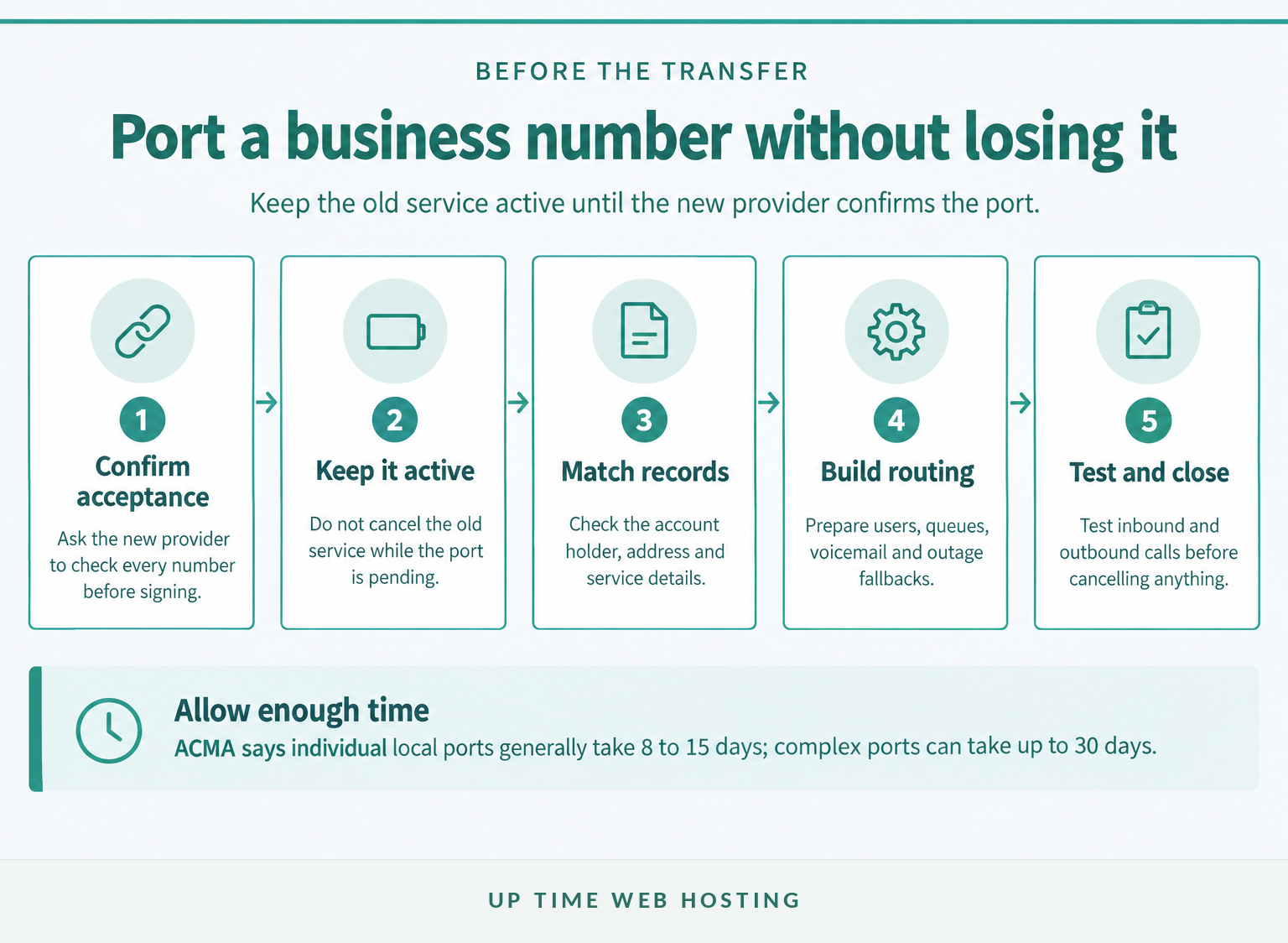
Australian businesses can usually port active geographic, mobile, 13, 1300 and 1800 numbers to a provider willing to accept them. Keep the existing service active until the new provider confirms that the port and call routing are complete.
The ACMA says a mobile port usually takes about three hours. Individual local-number ports generally take 8 to 15 days, while complex ports involving more than one local number can take up to 30 days, with limited exceptions.
A safer migration follows five steps:
- Confirm acceptance. Give the new provider every number and ask which can be ported before entering a contract.
- Keep the old service active. Do not cancel it, because disconnected numbers normally cannot be ported.
- Match the records. Check the account holder, service address, account number and authorised contact details.
- Build the destination first. Configure users, menus, queues, voicemail and outage routes before the port date.
- Test before closing anything. Call from multiple networks, make outbound calls and check every published destination before cancelling old services.
Mobile ports require additional identity checks. Local and inbound-number transfers may also involve provider forms, fees or coordination with an upstream carrier, so ask for the process and expected interruption in writing.
Keep the old service active until the new provider confirms the port and every route has been tested.
Register your new domain name at competitive market prices including free domain add-ons like privacy, DNS Hosting, Custom Nameservers and Forwarding.
Always the best price and no nasty renewal price hikes.
Register A Domain Name
What should you check before ordering an Australian VoIP number?
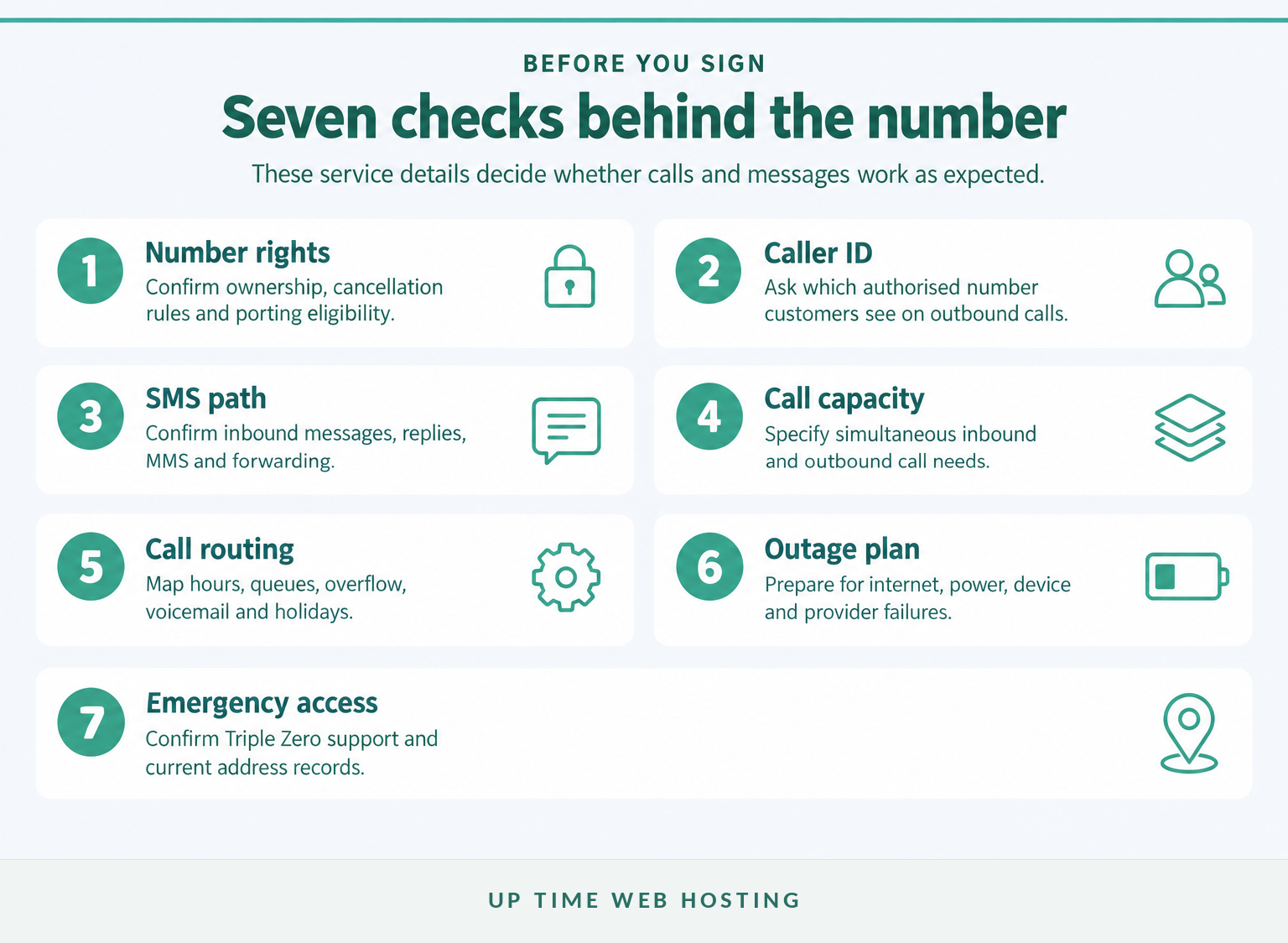
Check the service behind the number, not just the prefix and monthly rental. A useful quote should state number ownership, porting, caller ID, SMS, concurrent-call capacity, routing, outages, emergency calling and all recurring or once-off charges.
Use this checklist when comparing quotes:
- Rights of use: Confirm who holds the number, whether it can be ported later and what happens if the service is cancelled.
- Outbound caller ID: Ask which authorised number customers will see and whether returned calls reach the intended team.
- Concurrent calls: State the busiest expected period and ask how many inbound and outbound calls can remain active at once.
- Busy-call behaviour: Confirm whether a second caller enters a queue, reaches voicemail, follows overflow routing or receives an engaged signal.
- SMS: Separate inbound SMS, outbound SMS, two-way replies, MMS, bulk messaging and SMS-to-email because they may have different limits.
- Routing: Map business hours, public holidays, queues, voicemail, overflow, after-hours support and staff departures.
- Outage fallback: Decide what happens during an internet, power, device or provider outage. A diversion to a charged mobile may be different from a PBX-level fallback.
- Emergency calls: Confirm that the service supports Triple Zero and that the provider holds current address information.
- Total cost: Include number rental, users, call paths, devices, porting, setup, call recording, storage, support, inbound minutes and GST.
The ACMA says 000 can be called from certain VoIP services, not every conceivable internet-calling application. Its emergency-call guidance also explains that operators may ask a mobile or VoIP caller for the town and state, and that most NBN-connected services will not work during a power outage.
Run a practical two-call test before launch. Call the advertised number from two separate mobiles while a staff member makes an outbound call, then confirm that the second inbound caller follows the expected queue or overflow rule rather than receiving an unexpected busy signal.
The prefix is visible, but caller ID, SMS, call capacity, routing and outage behaviour decide whether the service works.
Can an Australian VoIP number receive SMS or work with WhatsApp?
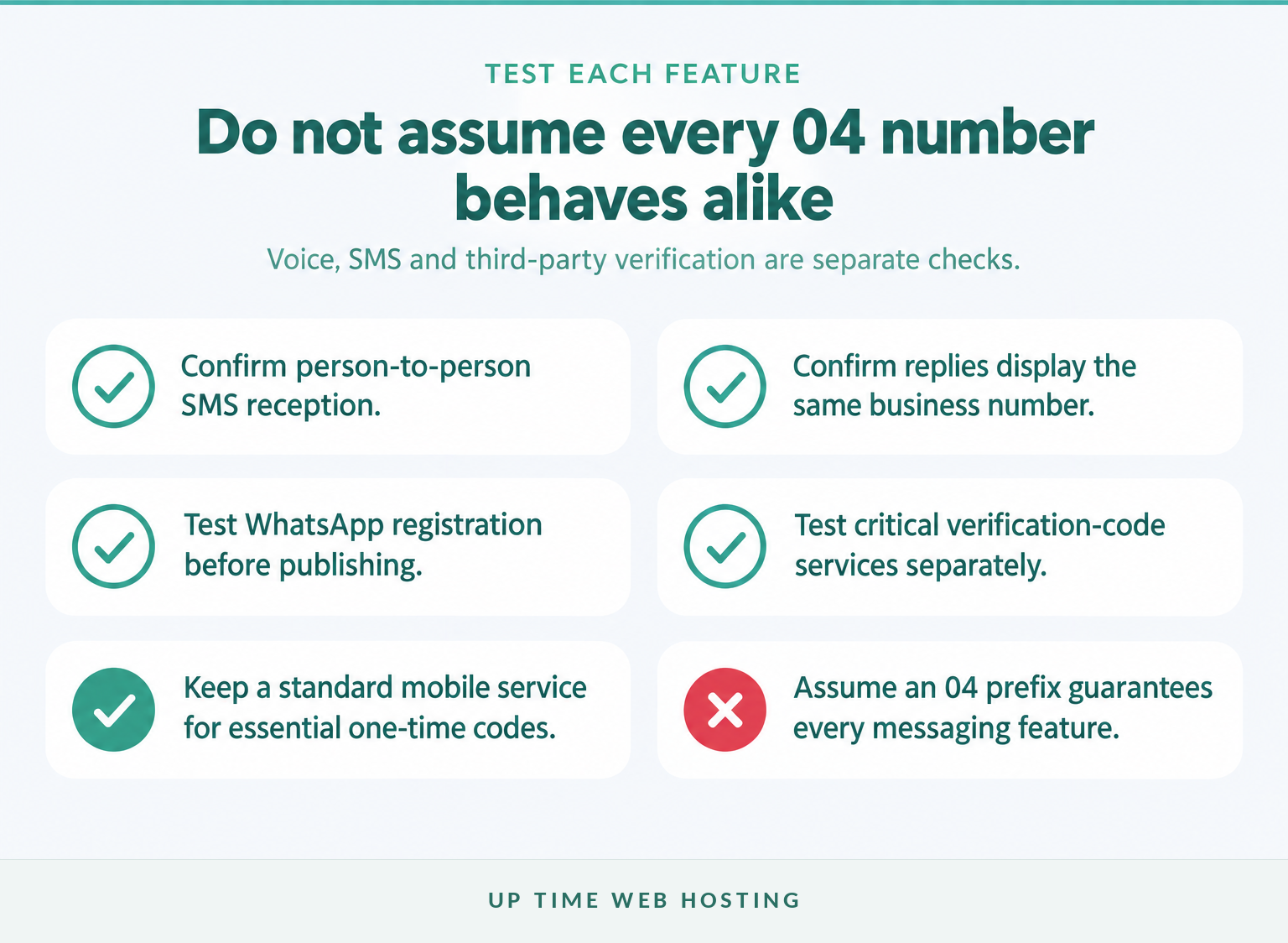
An Australian VoIP number can receive SMS only when the chosen number type and provider explicitly support it. WhatsApp and verification-code acceptance are separate platform decisions, so neither should be assumed from an 04 prefix or an SMS feature alone.
Ask the provider to demonstrate the exact messaging workflow. A service that forwards inbound SMS to email may not let staff reply from the same number, while an application that supports two-way person-to-person SMS may still restrict automated or high-volume messages.
As of November 2026, WhatsApp Help Centre's registration requirements list VoIP and toll-free numbers as unsupported for registration. WhatsApp says landlines are supported only through the WhatsApp Business application, and the number must be able to receive the required SMS or voice call.
A virtual 04 number may therefore work for ordinary calls and texts but still fail registration if the platform identifies it as VoIP or otherwise declines the number. Test the actual number before printing it on signs, moving customer conversations or depending on it for account recovery.
Free or disposable Australian numbers are particularly poor business assets. They may offer no lasting control, no porting rights, limited support and no guarantee that banks, messaging applications or verification services will accept them.
Treat WhatsApp and verification-code acceptance as a separate platform test, not a promised feature of the VoIP number.
Experience Microsoft 365 Business Standard for free for 30 days.
Up to 25 users with full access to email, OneDrive and Teams. Includes full versions of desktop apps of Outlook, Word, Excel, PowerPoint and more.
Try Microsoft 365
What else do Australian businesses ask about VoIP numbers?
Most follow-up questions concern Australian number formats and verification rather than call routing. These answers separate the national numbering format from features that depend on the provider or a third-party platform.
What is a VoIP number?
A VoIP number is a normal public phone number connected to a service that carries calls over Internet Protocol. Customers dial it like any other number. A hosted PBX or SIP service then routes the call to authorised desk phones, computer applications, mobiles, queues, voicemail or other destinations set by the business.
What is a 10 digit Australian mobile number?
An Australian mobile number has 10 digits when written domestically and starts with 04, for example 04xx xxx xxx. In international format, remove the leading zero and add +61. A virtual mobile service may use the same 04 format, but its voice, SMS and application support depend on the provider.
What is a 12-digit phone number?
A 12-digit phone number is not a standard Australian geographic or mobile format. Australian local and mobile numbers are normally 10 digits domestically, or +61 followed by nine digits internationally. If 12 digits appear, check the country code, spacing and source before treating it as an Australian business number.
How to check mobile phone number?
To check a mobile number, look in the phone's SIM or device settings, the telco account, a recent bill, or call another phone and view the caller ID. For a virtual business mobile number, confirm the number and rights of use in the provider portal before publishing or attempting a port.
Australian number format is predictable, but application acceptance and service features must still be confirmed.
What should you do next?
Write down the number identity customers should see, the simultaneous calls required, the users who answer, the SMS workflow and the outage fallback. Then ask each provider to quote against that same list rather than requesting a generic VoIP number.
UpTime's Australian business VoIP options include Hosted PBX, Virtual Mobile, 1300 and 1800 numbers, SIP trunking and call-routing features. Request a number and call-flow plan that confirms porting, caller ID, SMS and concurrent-call capacity before any existing service is moved.
Choose the number by the job it must do, then verify the service details that determine whether calls reach the right person.